Daksh Pandey
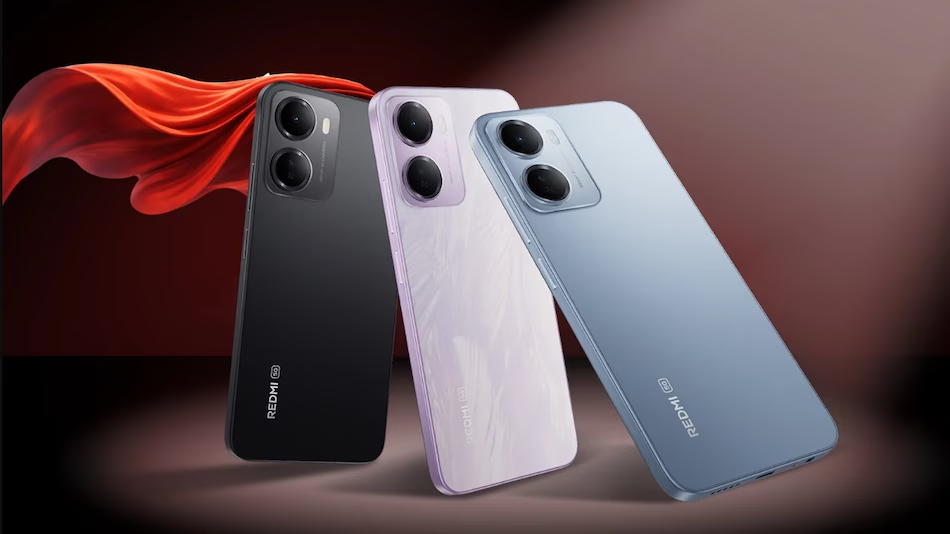
Xiaomi has kicked off 2026 in India with a very “Redmi” kind of launch: a value-focused smartphone for the masses and a big-screen tablet that’s trying to blur the line between entertainment device and light productivity machine. The company has introduced the Redmi Note 15 5G and the Redmi Pad 2 Pro 5G (along with a Wi-Fi-only Redmi Pad 2 Pro variant), aiming at two of the busiest price segments in the country—mid-range phones and affordable Android tablets.
What makes this launch interesting isn’t just the hardware. It’s the direction Xiaomi is leaning into: an ecosystem pitch. With the tablet, Xiaomi is openly pushing optional accessories like a keyboard and stylus to position the Pad 2 Pro as a “next step” device for students, creators, and people who want a bigger screen without paying flagship-tablet money.
Below is a deep, detailed breakdown of what Xiaomi launched, what you get for the price, and who these devices are actually for.
The bigger picture: why Xiaomi paired a phone and a tablet launch
India’s gadget market has changed a lot in the last couple of years. Smartphones have become more durable and more “complete” even at mid-range prices, while tablets have quietly returned as a serious category—especially for online learning, streaming, casual gaming, reading, and work-from-anywhere needs. Xiaomi is trying to catch both waves at once.
By launching the Redmi Note 15 5G and Redmi Pad 2 Pro 5G together, Xiaomi is essentially saying: your main screen can be your phone, and your second screen can be an affordable tablet that works like a mini-laptop when you want it to. That’s why the accessories story matters here: the phone is the everyday device, while the tablet is meant to become the “home base” for longer sessions—classes, notes, movies, browsing, document work, video calls, and even some light creative work.
This also matches what Redmi has always been good at: selling “spec-heavy” products that look like they belong in higher price brackets. The phone focuses on camera + display + performance balance, while the tablet focuses on display + battery + entertainment + productivity add-ons.
Redmi Note 15 5G: what Xiaomi is offering this time
Pricing and variants
The Redmi Note 15 5G starts at ₹22,999 in India.
According to sale listings and coverage, there are at least two storage configurations commonly highlighted: 8GB RAM + 128GB and 8GB RAM + 256GB, with the higher storage version priced higher (for example, ₹24,999 has been reported for the 256GB variant in sale coverage).
Also, Xiaomi and retail partners have pushed bank offers around the launch window, with instant discounts on select card transactions bringing effective prices lower (figures like “up to ₹3,000 discount” have been reported in first-sale coverage).
Core performance: Snapdragon 6 Gen 3
At the heart of the Redmi Note 15 5G is the Snapdragon 6 Gen 3 chipset.
This is a “sweet spot” choice for the segment: it’s designed to deliver reliable daily performance, good 5G efficiency, and stable sustained output for typical gaming and multitasking—without pushing the price into premium territory.
In real-world terms, this chipset choice usually targets people who:
- keep their phones 2–4 years and want steady performance,
- juggle social apps, camera, streaming, and browsing,
- play popular titles (often at medium/high settings rather than ultra),
- care about efficiency because battery anxiety is real.
Display: curved AMOLED with a big brightness push
Xiaomi is pushing a premium feel through the screen: the Redmi Note 15 5G gets a 6.77-inch curved AMOLED display with 120Hz refresh rate, and Xiaomi highlights very high peak brightness for outdoor readability (the product page mentions 3200 nits peak brightness) along with HDR support.
Curved AMOLED in this segment is a design statement. Some people love it because it looks and feels flagship-like in the hand. Others prefer flat displays for fewer accidental touches and easier screen protector use. Xiaomi’s bet here is clear: a curved panel makes the device feel more expensive than it is.
Cameras: 108MP main + OIS and 4K
For a lot of Indian buyers, the camera spec is the headline. Xiaomi is marketing the Redmi Note 15 5G as a “108 MasterPixel” style device, and the product pages and coverage emphasize a 108MP main camera with OIS and 4K recording with OIS support.
What does that actually mean for regular users?
- 108MP can capture more detail in good light, and can help with cropping.
- OIS (optical image stabilization) is the bigger practical upgrade: it improves low-light photos, reduces blur, and stabilizes videos.
- 4K video with OIS is a meaningful creator-friendly feature at this price, assuming Xiaomi’s processing and stabilization tuning are solid.
Of course, megapixels aren’t everything. The final camera experience depends heavily on processing, HDR tuning, skin tones, shutter speed, and consistency across lighting conditions. But Xiaomi clearly wants the Note 15 5G positioned as the phone you buy when your priority is “good photos without paying premium prices.”
Battery and charging
The Redmi Note 15 5G packs a 5520mAh battery and supports 45W fast charging (as highlighted on Xiaomi’s India event page for the device).
This combination is designed for the “full-day” promise:
- heavy scrolling + camera + streaming users should still reach evening comfortably,
- moderate users can often stretch into a second day,
- 45W charging means you can top up quickly without the heat and cost tradeoffs of very high-wattage systems.
Durability and software angle
Xiaomi is also highlighting IP66 dust and water resistance on the Redmi Note 15 5G marketing pages.
And on software, the device is positioned around Xiaomi’s ecosystem experience (HyperOS branding appears across the company’s latest product stack).
Redmi Pad 2 Pro and Redmi Pad 2 Pro 5G: Xiaomi’s big battery, big screen play
If the phone is about “flagship-feel on a budget,” the tablet is about “big screen freedom without constantly hunting for a charger.” Xiaomi is going straight for the pain points: display quality, speakers, battery life, and accessories.
Pricing and variants (India)
The Redmi Pad 2 Pro series comes in multiple configurations, including Wi-Fi-only and 5G versions. Reported pricing from Indian launch coverage includes:
- ₹24,999 for 8GB + 128GB Wi-Fi variant
- ₹27,999 for 8GB + 128GB Wi-Fi + 5G
- ₹29,999 for 256GB Wi-Fi + 5G
Launch offers have been reported as well, including instant bank discounts (figures like ₹2,000 off on select bank cards were mentioned), effectively bringing the starting price down during the promo window.
Display: 12.1-inch 2.5K, 120Hz
Xiaomi is using the screen to justify the “Pro” name. The Redmi Pad 2 Pro 5G is promoted with a 12.1-inch 2.5K display and 120Hz refresh rate.
This is the kind of display spec that makes a tablet feel instantly premium:
- text looks crisp for reading and study,
- content looks sharp for streaming,
- 120Hz makes scrolling and UI navigation feel very smooth,
- it’s big enough for split-screen multitasking (notes + video, PDF + browser, etc.).
Battery: 12,000mAh is the star
The biggest headline is the battery. Xiaomi is shipping the tablet with a 12,000mAh battery, and it’s being marketed as a “no-plug all-play” kind of device built to last long sessions.
In practical use, a battery this size typically means:
- multiple movies or a full day of classes without panic,
- long reading sessions,
- less dependence on carrying chargers everywhere,
- better standby confidence if you don’t use the tablet daily.
Battery is also a lifestyle feature. A tablet that’s always ready becomes the household screen—shared by family members, used for quick searches, kids’ learning apps, video calls, or casual gaming.
Processor: Snapdragon power
Coverage notes the Redmi Pad 2 Pro 5G is powered by a Snapdragon 7s Gen 4 SoC.
That’s a strong mid-range tablet chip choice, especially when paired with a high-refresh display. It’s aimed at:
- smooth multitasking,
- stable gaming performance for mainstream titles,
- better efficiency for long battery life,
- consistent UI fluidity at 120Hz.
Speakers and entertainment focus
For tablets, audio matters a lot because people actually use the speakers (unlike phones where many switch to earbuds). The launch coverage highlights a quad-speaker setup tuned with Dolby Atmos.
That’s a direct message: this tablet is built for Netflix/YouTube/Hotstar sessions, music, casual gaming, and video calls. Combined with the 12.1-inch display, it’s meant to feel like a mini theatre screen.
Software: Android 15 + HyperOS ecosystem
Launch coverage mentions Android 15 for the tablet lineup and Xiaomi positions the experience under HyperOS 2, focusing on interconnectivity features across devices.
For buyers, this matters if you already use a Xiaomi/Redmi phone. Ecosystem features (file sharing, app continuity, synced notifications, quick pairing) become more useful when both your phone and tablet are inside the same brand family.
Accessories: Xiaomi wants the tablet to feel like a “budget laptop alternative”
This is where Xiaomi is trying to change the conversation. The Redmi Pad 2 Pro isn’t just “a big screen for videos.” With accessories, it becomes “a device you can type on and take notes with.”
Redmi Smart Pen
Xiaomi lists the Redmi Smart Pen at ₹3,999 on its India accessories catalog pages.
For students and note-takers, a stylus can be a huge value add:
- handwritten notes in classes,
- annotating PDFs,
- sketching diagrams,
- brainstorming mind maps,
- signing documents.
The key is whether the pen experience is low-latency and well-integrated. Xiaomi pushing it alongside the Pad 2 Pro suggests the company wants people to seriously consider the pen as part of the purchase, not an afterthought.
Redmi Pad 2 Pro Keyboard
Xiaomi also lists the Redmi Pad 2 Pro Keyboard at ₹3,999 in its accessories listings.
And keyboard product pages (global and related listings) emphasize a “PC-level typing experience” style pitch—large keys, decent key travel, and a layout meant to support longer typing sessions.
This matters because it changes who the tablet is for. With a keyboard:
- students can type assignments,
- professionals can reply to emails and edit docs,
- creators can script and plan,
- casual users can browse and message faster.
A tablet with a big screen and optional keyboard is often the “I don’t want to buy a laptop yet” device.
Availability and where these devices are being sold
Launch coverage indicates the Redmi Note 15 5G went on sale shortly after launch and is available via major platforms (including Amazon listings that show the device and pricing).
For the Pad 2 Pro 5G, launch reporting notes availability via the company’s website and retail channels around the post-launch window, with pricing and bank offers highlighted in Indian coverage.
Who should buy what?
Buy the Redmi Note 15 5G if you want:
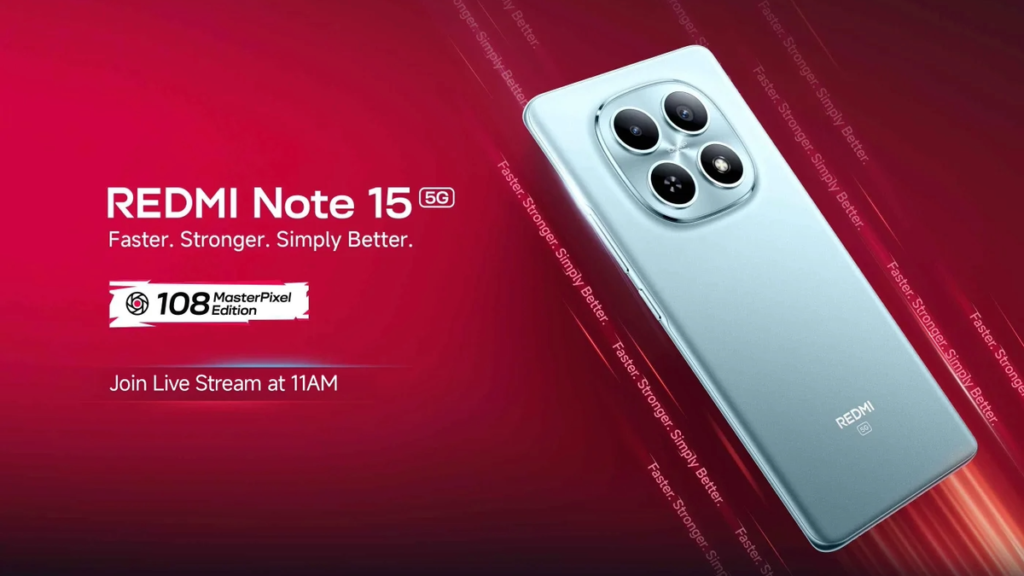
- a mid-range phone with a premium-feel curved AMOLED experience,
- a strong “main camera first” setup with 108MP + OIS + 4K OIS video,
- efficient performance with Snapdragon 6 Gen 3,
- a larger battery + reasonably fast charging (5520mAh, 45W).
This is for the person who wants a complete, modern daily driver under the psychological “mid-range ceiling,” but doesn’t want the phone to feel basic.
Buy the Redmi Pad 2 Pro 5G if you want:
- a big 12.1-inch 2.5K 120Hz display for media + multitasking,
- massive 12,000mAh battery life for long sessions,
- quad speakers with Dolby Atmos for entertainment,
- a tablet that can become more productive with a ₹3,999 keyboard and ₹3,999 stylus.
This is for students, binge-watchers, and “second screen” buyers who want a tablet that doesn’t feel like a compromise.
Final takeaway: Xiaomi’s strategy is clear
With the Redmi Note 15 5G, Xiaomi is reinforcing what Redmi Note phones usually represent in India: big specs, camera focus, strong display, and a “flagship vibe” without flagship pricing.
With the Redmi Pad 2 Pro 5G, Xiaomi is making a serious push into the “value tablet” space by combining a large high-res screen, huge battery, loud speakers, and optional accessories that make it feel closer to a lightweight laptop alternative.