Daksh Pandey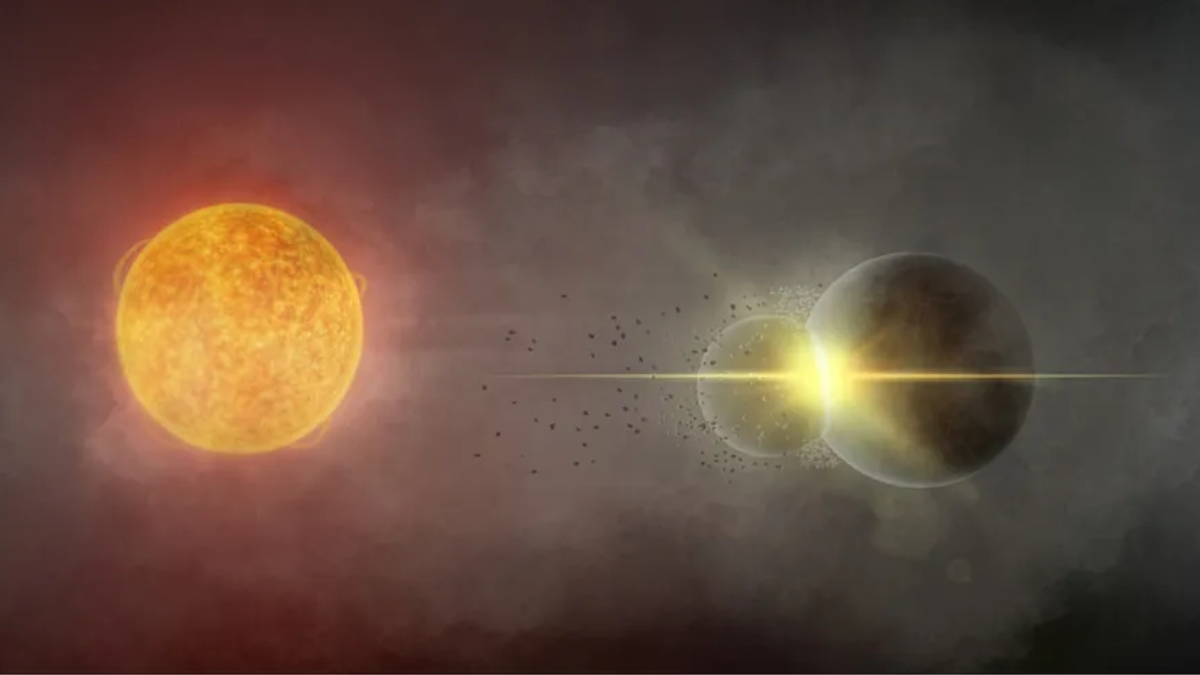
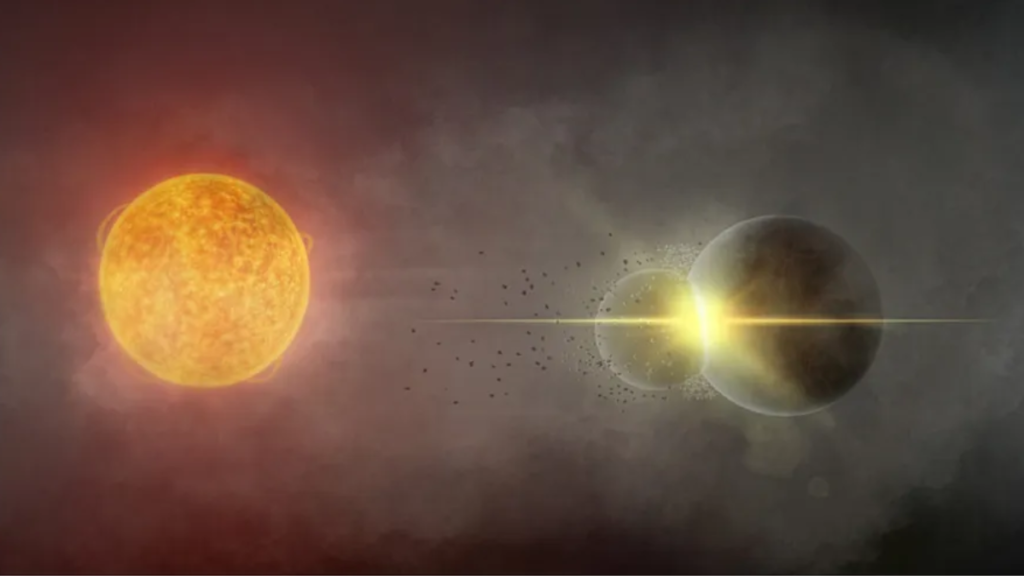
The discovery of a cosmic outburst linked to a massive planetary collision around the star Gaia20ehk is super exciting. Scientists think they’ve found the aftermath of two planets smashing into each other. This created a cloud of hot debris and changed the stars brightness.
1. **The Star Gaia20ehk and the Cosmic Outburst**
### Location and Characteristics
Gaia20ehk also called Gaia-GIC-1 is a F-type star. It’s about 11,000 to 11,500 years away from Earth in the Puppis constellation.
Some key things about Gaia20ehk:
* Mass: 1.3 times that of the Sun
* Temperature: around 6,400 K
* Type: young variable star
* Location: deep in the Milky Way galaxy
Astronomers started studying Gaia20ehk when it began behaving. A stable star started showing changes in brightness. This suggested something unusual was happening in its system.
2. **How Scientists First Detected the Event**
### Unusual Changes in Brightness
The first clues showed up in 2016. The star had dips in brightness that lasted months. By 2021 its light output became more erratic.
Astronomers noticed two patterns:
* Visible light from Gaia20ehk decreased
* Infrared radiation increased a lot
This opposite behavior puzzled researchers. Stars don’t usually produce patterns on their own.
### The Infrared Clue
The mystery was solved when scientists looked at Gaia20ehk using telescopes. They found:
* As Gaia20ehk dimmed in light
* It became much brighter in light
This suggested hot dust and debris were blocking the star. They were also glowing due to their temperature.
This type of observation strongly indicates a large-scale collision between bodies.
3. **The Planetary Collision Hypothesis**
Scientists now think the cosmic outburst was caused by two planets colliding in the Gaia20ehk system.
Here’s what likely happened:
* Two planets orbited Gaia20ehk.
* Their orbits became unstable.
* They had collisions that scraped their surfaces.
* Eventually they had an impact.
The collision produced a cloud of hot rock, dust and vapor. This debris cloud is what astronomers observe today.
4. **Size and Energy of the Collision**
Planetary collisions are among the energetic events in planetary systems.
Scientists estimate the debris cloud contains:
* Around 10²⁰ kilograms of dust
* Material heated to 900 Kelvin
* Debris spreading over a region 0.13 AU² in area.
This amount of material is comparable to the mass of the dwarf planet Ceres.
The impact would have released energy. It could:
* Vaporize rock
* Melt planetary crusts
* Create glowing debris clouds visible across distances.
5. **How Astronomers Confirmed the Collision**
Researchers used instruments and telescopes.
Some key instruments included:
* ESA’s Gaia spacecraft
* Infrared telescopes
* Ground-based observatories
* NASA’s WISE infrared mission
These instruments monitored:
* Changes in brightness
* Dust cloud expansion
* Infrared radiation from debris.
Together these observations strongly support the planet-collision explanation.
6. **Why This Event Is So Rare**
Astronomers think planetary collisions are common during the stages of solar system formation.. Directly observing them is extremely rare.
Reasons include:
* Collisions happen quickly on timescales.
* Debris clouds may fade within decades.
* Observatories must be looking at the star at the right moment.
So catching one in progress is extremely unusual.
Researchers describe the discovery as ” rare.”
7. **Connection to the Formation of Earth’s Moon**
The Gaia20ehk event is exciting because it resembles a theory about our own solar system.
### The Giant Impact Hypothesis
According to the Giant Impact Hypothesis the Moon formed when:
* A Mars- object called Theia
* Collided with the Earth
* About 4.5 billion years ago
The impact created a debris disk that eventually formed the Moon.
Scientists think the Gaia20ehk collision may represent an event happening elsewhere in the galaxy.
8. **Possible Formation of New Moons or Planets**
After collisions debris can gradually combine into new celestial bodies.
Possible outcomes include:
* Formation of moons
* Creation of smaller planets
* Development of asteroid belts
The dust cloud around Gaia20ehk orbits the star at roughly 1 astronomical unit (AU). This is similar to the Earth-Sun distance.
This region is ideal for planet formation.
9. **The Role of Dust Clouds**
The collision produced a debris cloud composed of:
* Vaporized rock
* Melted planetary crust
* Dust particles
These clouds:
* Block starlight
* Glow strongly in wavelengths
* Spread gradually around the star.
This is why Gaia20ehk’s brightness fluctuates.
10. **A Possible “Synestia”**
Some researchers think the collision may have formed a structure called a synestia.
A synestia is:
* A rotating mass of vaporized rock
* Formed during violent planetary impacts.
Inside a synestia:
* Rock becomes vapor
* Material spreads into a donut-shaped cloud
* Moons can eventually form.
Evidence suggests Gaia20ehk might have produced such a structure.
11. **Observing Planetary System Evolution in Real Time**
One of the exciting aspects of this discovery is that scientists may be witnessing planet formation in real time.
Usually astronomers only see:
* Mature planetary systems
*. Ancient remnants of collisions.
Gaia20ehk allows researchers to observe:
* Debris formation
* Dust evolution
* Orbital dynamics
as the system changes.
12. **Comparison With Other Planetary Collision Systems**
A few other stars have shown evidence of similar collisions. These include:
* HD 166191
* V488 Persei
* NGC 2547-ID8
However Gaia20ehk appears to be one of the examples ever observed.
13. **What This Discovery Means for Planet Formation**
The event provides clues about:
1. Planetary system evolution
Many planetary systems likely experience collisions during their early stages.
2. Formation of terrestrial planets
Earth- planets may form through repeated collisions of smaller bodies.
3. Moon formation
Large moons may commonly originate from impacts.
4. Habitability
These collisions can influence whether a planet eventually becomes habitable.
14. **Future Observations**
Astronomers plan to continue observing Gaia20ehk using:
* Infrared telescopes
* Space observatories
* Next-generation instruments.
One future tool expected to help is the Vera C. Rubin Observatory. This may detect more such collisions.
Over the decade scientists hope to find dozens of planetary collisions across the galaxy.
15. **Challenges in Studying Planetary Collisions**
Studying events is difficult because:
* Dust clouds obscure the central star.
* Collisions produce debris patterns.
* Observations require wavelengths.
Despite these challenges Gaia20ehk provides a laboratory for studying these phenomena.
16. **Broader Implications for Astrobiology**
collisions may influence the development of life.
They can:
* Deliver water and organic molecules
* Create moons
* Alter planetary climates.
For example Earth’s Moon stabilizes our planet’s rotation. This may have helped life evolve.
Studying Gaia20ehk may help scientists understand how common life-friendly planets might be in the universe.
17. **Why This Discovery Matters**
This cosmic event is important for reasons:
* It provides evidence of planetary collisions.
* It offers a snapshot of planet formation processes.
* It helps test theories about moon formation.
* It improves our understanding of planetary system evolution.
In essence Gaia20ehk allows astronomers to watch a stage in the life cycle of planets.
The rare cosmic outburst observed around Gaia20ehk is likely the aftermath of a planetary collision. This produces a glowing debris cloud across thousands of light-years.
This discovery offers scientists a chance to study one of the most violent processes in planetary evolution. These are impacts that shape planets and moons.
By observing this event astronomers gain insights, into the processes that once shaped our own solar system. This includes the collision that formed the Moon.
As future telescopes monitor Gaia20ehk. Discover more similar events, our understanding of how planets form, evolve and potentially support life will continue to expand.