Daksh Pandey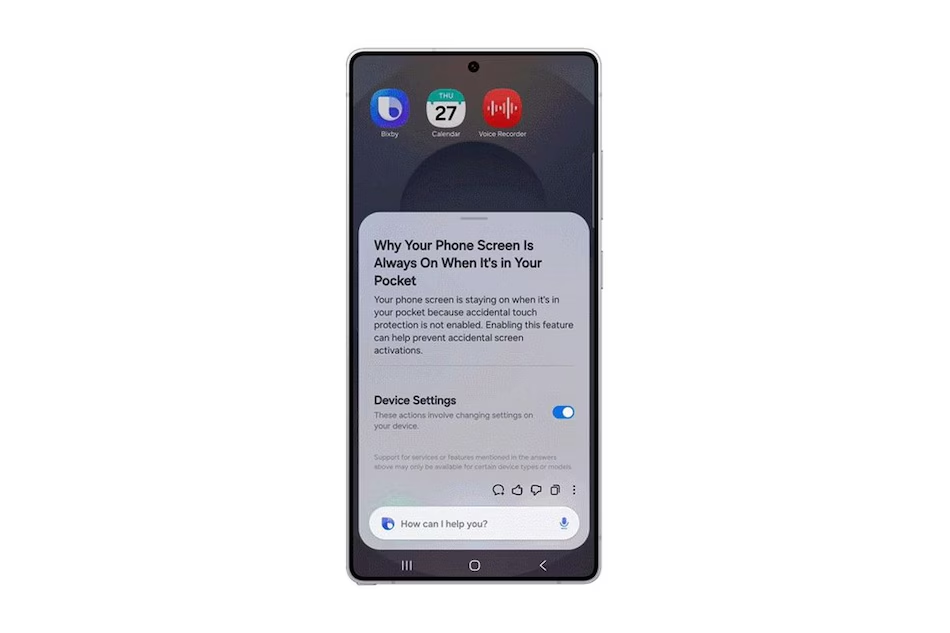
Samsung has announced that the next update to its Android skin One UI 8.5 will bring a change to its virtual assistant, Bixby. This version of Bixby is going to be a device agent. It will understand natural language perform more tasks on the device and can fetch live information from the web in real time.
What is changing is that Bixby will have natural language control, device agency and live web results. At its core the One UI 8.5 Bixby update changes three things:
* Natural language control for device features. You can give Bixby commands like “Set my phone for evening mode and mute notifications from work apps after 9 PM”.
* Agentic behavior. Bixby is being upgraded from a helper to a proactive agent that can manage tasks on behalf of the user.
* Real-time web access. Bixby can now perform web searches and return up-to-date answers inside its own UI.
These three capabilities together change Bixby from an assistant to something closer to a lightweight device-bound AI agent. The technical glue that makes this work is models, search partners and on-device context.
Samsung’s announcement describes the Bixby as a “conversational device agent” which implies multiple layers of technology working together. Natural language understanding is necessary for Bixby to interpret multi-clause follow-up questions. Device action mapping and orchestration are necessary for Bixby to execute changes safely. Live web synthesis via a search partner is necessary for Bixby to fetch facts, news and other time-sensitive information.
The experience will feel more natural and conversational to users. You can ask Bixby questions like a person. It will interpret the intent and search availability. Bixby will remember the thread of a conversation so you can ask follow-ups without repeating context.
Bixby will have device control so you can toggle a chain of settings or create custom do-not-disturb rules with one-shot natural commands. You can get answers without app switching so you can ask about live data like scores, flight status or weather and Bixby will pull it up inside the assistant.
The new Bixby is being tested within the One UI 8.5 beta program. Early availability has been reported on Galaxy S25 devices and in markets. The exact devices and timing will expand as beta testers report back. Samsung completes validation.
Samsung is making this move to differentiate the Galaxy ecosystem regain relevance and pursue a strategy between on-device and cloud AI. A capable Bixby could enable new user flows across TVs, home appliances and cars.
However there are risks and limitations to consider. The accuracy of web synthesis is a concern as sourcing real-time answers from the open web introduces risk of outdated or incorrect summaries. Latency and performance are also concerns as synthesizing web answers and combining them with device actions can introduce delay.
Privacy considerations are also important as combining device context with a web retrieval backend raises data-flow questions. Samsung’s documentation signals attention to consent and local processing where possible. Users will likely demand transparent controls.
Samsung has emphasized user control and consent noting that many decisions about what’s processed locally and what is processed remotely are designed with privacy in mind. Users will be able to control Bixby’s permissions and opt out of data uses. The transparency of those controls will be central to user trust.
Overall the new Bixby is a change to Samsung’s virtual assistant. It has the potential to make Bixby more useful and conversational. It also raises concerns, about accuracy, latency and privacy.
Samsung is going to give users a permissions page that shows what Bixby can access on their device like their calendar, contacts, microphone and notifications.
This is a thing because users will know what Bixby is doing. When Bixby gives answers from the web it should show where it got the information from so users can check if it is true.
There might be settings that let users choose if they want Bixby to use the web or just the device to help them.
This change will affect developers who make apps for Android devices. They might be able to make their apps work with Bixby so users can do things with their voice. For example a user could say “send my photo to the printer app and print it”. Bixby would do it.
Developers will have to make sure their apps can understand what users are saying and do what they want. They will also have to test their apps to make sure they work well with Bixby.
If Bixby is good it will make companies that make assistants like Google work harder to make their assistants better.
Bixby is different from assistants like Siri and Google Assistant. It works closely with the device. Can do things that other assistants cannot.
It can also give answers from the web in an useful way. Bixby is focused on helping users get things done than just answering questions.
Samsung has to make sure Bixby works well and gives accurate answers. If it does Bixby could become an useful tool for users.
People who have tried the Bixby say it is convenient and easy to use but sometimes it does not understand what they are saying.
There are a things that Samsung needs to work on like making sure Bixby gives accurate answers from the web and does what users ask it to do.
They also need to make sure users know what information is being sent from their device and why.
Here are some examples of how Bixby could be useful:
* Planning a trip: a user could say “find flights to Delhi weekend and book the cheapest one” and Bixby would do it.
* Getting ready for bed: a user could say “make my phone ready for bed”. Bixby would turn on dark mode set the phone to do not disturb and reduce the screen brightness.
* Helping with meetings: a user could say “get ready for my meeting”. Bixby would pull up the slides, mute notifications and open the minutes document.
* Finding information: a user could say “what are the COVID testing centers near me” and Bixby would show them the options.
These examples show how Bixby could make it easier for users to get things done.
Overall the new Bixby is a step forward, for Samsung. It has the potential to be very useful. Samsung needs to make sure it works well and gives accurate answers.