Daksh Pandey
1) Why Samsung may use BOE displays for further devices
The headline of what’s being rumored
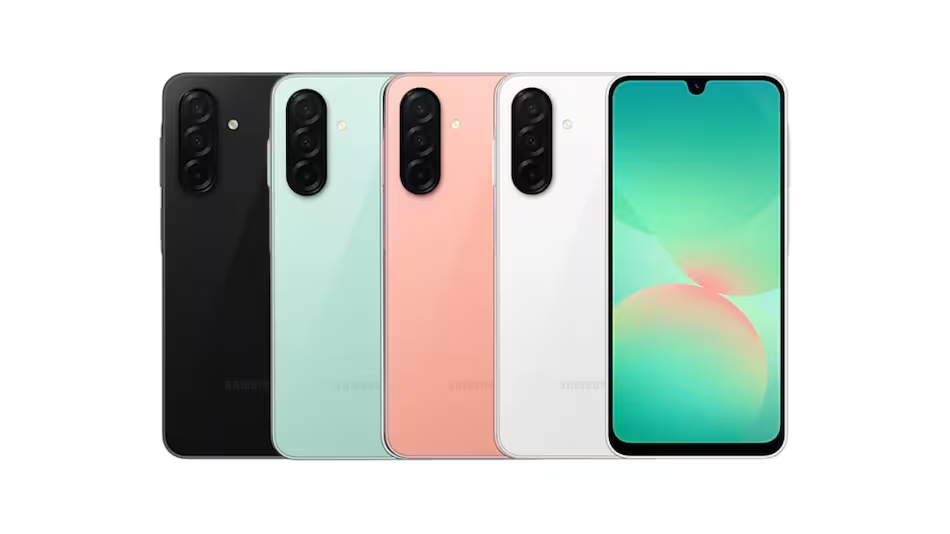
A variety of reports this week suggest Samsung is contemplating purchasing display panels from BOE, especially small OLED panels for Galaxy phones but possibly large LCD panels for TVs.
On its face, that sounds surprising because Samsung already has one of the world’s most powerful in-house display arms in the form of Samsung Display. Why source from a Chinese rival at all?
The answer is: cost, supply-chain flexibility, and leverage—plus a changing legal/relationship backdrop.
A rough map of “Samsung” (it’s not one company internally)
People refer to “Samsung” in a manner that makes the company sound like a single unit, but in reality:
Samsung Electronics wants only the best screens for the best price in phones.
Samsung Display is a separate business that sells panels-it sells to others-and it wants margins and capacity utilization.
Sometimes their incentives are aligned; sometimes they aren’t.
If the costs of phones go up, then Samsung Electronics may want cheaper panels or a second supplier, even if Samsung Display can build them, because internal transfer pricing, capacity planning, or negotiating power still matter.
The “why now” : component inflation + margin pressure
Among the common themes in reports is how the rising component costs of premium smartphones-different chipsets, camera parts, memory, and manufacturing overhead-finally asked brands to do one of three things:
Increase retail price-risky in competitive markets
Accept lower margins-investors don’t like it.
Reduce bill-of-materials cost where the display is a big chunk
OLED panels are among the most expensive phone parts, especially those at flagship quality. If Samsung can qualify BOE for even a portion of production, that immediately creates negotiating leverage that can reduce overall cost.
Diversifying suppliers isn’t “anti–Samsung Display”; it’s common-sense risk management.
Even Apple, which has very strict component qualification, uses multiple display suppliers where possible: Samsung Display, LG Display, BOE in limited contexts depending on model/region. So do many Android OEMs. Having a second supplier helps with the following:
Supply shortages
Yield issues if one factory line has issues
Geopolitical / trade disruptions
Price negotiation
Scaling production faster for big launches
So, the move isn’t inherently shocking; what is noteworthy is that it would involve BOE in higher-tier Samsung devices if the rumor is accurate.
It was EXCLUSIVE to technology.
The Relationship Factor: Legal Fights, Cooling-Off, and “Reset”
Serious IP disputes have taken place between Samsung Display and BOE. Coverage regarding the developments of the OLED industry mentions outcomes of US trade/ITC-related actions that present an influence on the AMOLED business of BOE, while BOE has been able to circumvent such constraints.
The reporting tone now is that ties may be warming again and senior executives have met to discuss collaboration.
In a nutshell, what appeared to be a tough competition can still transform into a buyer–supplier relationship when business incentives align.
But can BOE match “Samsung flagship” OLED quality?
This is essentially the important technical question.
On flagships, a screen isn’t just “OLED.” It’s a bundle of requirements:
Uniformity-no “mura” patches
Brightness: typical + peak HDR
Color calibration
LTPO- Low-Temperature polycrystalline oxide or similar Variable Refresh technology
Power efficiency
High-frequency PWM / flicker behavior
Touch sampling
Durability
Polarizer/anti-reflection stack
Curved glass lamination yields curved
Quality consistency at scale
BOE has been rapidly improving and shipping OLEDs in significant volume, but “qualifying” to supply a Samsung flagship typically would indicate that BOE has met Samsung’s target metrics consistently at massive volumes-and not just in a lab sample run.
That’s why most reports use the phrase “considering,” “in talks,” or “could” when the news isn’t entirely confirmed.
Where BOE may eventually show up first-if it does
Based on how highly phone makers usually do second-sourcing, the most realistic patterns are:
A) Region-based sourcing
Same model of the phone, but some regions get the panels from Supplier A versus B. This is mostly invisible to consumers unless panel characteristics differ.
B) Tier-based sourcing
BOE boards can emerge first at:
lower-tier or “Fan” models,
non-Ultra variants,
or specific lots of production.
C) Component “mix” strategy
Primary would be Samsung Display, BOE covering a certain percentage to control cost and reduce risk.
It is also why rumors, at times, raise user anxiety, such as “Will my phone get a worse screen?”, even when brands try to keep the experience consistent.
The TV angle: LCD supply economics
Reports further indicate that BOE will be providing large LCD panels for Samsung smart TVs.
That is less surprising because the
Samsung is a leading brand in TV sales and sources panels externally in many segments.
BOE is a major LCD supplier.
TV margins are thin, and panel pricing matters a great deal.
So even if the phone OLED part is uncertain, the TV LCD part fits existing industry logic.
Geopolitical angle: Could politics complicate BOE sourcing?
Yes-especially in the US, where Reuters said US defense legislation language proposed examination of BOE for possible classification concerns in the context of “Chinese military company” evaluation. While that is not an automatic commercial ban, it is scrutiny.
This can matter in two ways for Samsung:
Any element of political sensitivity can make procurement/PR more complex.
Even if it were legal, perception risk or future restrictions can be an issue to consider when making long-term plans.
That doesn’t mean “Samsung won’t do it,” but that’s part of the risk calculus.
What it means for consumers- the practical effect
If Samsung uses BOE panels for some units of upcoming devices, the range of outcomes could be anything from “no one notices” to “enthusiasts notice subtle differences.”
Better price control-less chance of price hikes.
Improved supply at launch – fewer shortages
More competition within the panel market-innovation and price pressure.
Slightly different calibrations of brightness, uniformity, or flicker characteristics from batch to batch.
Harder for reviewers to generalize one unit to all units if panel sourcing varies
Most big makers try to match key specs tightly, but display “feel” can still vary.
2) Google “space-based AI data centers” and why orbital crowding/debris is a real problem
First, what Google actually published versus what people are speculating about
Google Research recently published a blog post to describe Project Suncatcher, a research direction that investigates a solar-powered satellite with TPUs-each linked using free-space optical links-to one day scale AI compute in space.
Taken separately, media coverage and commentary amplified this to “Google wants data centers in orbit”, sometimes attaching timelines like prototype steps around 2027.
So let the framing be clear:
Confirmed: Google is looking into an architecture concept and publishing technical thinking as Suncatcher.
Speculation/looking ahead: scale, time, and operating deployment.
Space
+1
Why bother with “compute in orbit”?
Earth-based AI computation has two brutal constraints:
Power: AI data centers require massive amounts of reliable electricity.
Cooling – (it is expensive and water-intensive to remove heat in some regions)
The explanation of orbit is:
Continuous solar energy – especially in certain orbits
Cold space as an ultimate heat sink though radiating heat is not “free”
Potential to avoid local grid bottlenecks
Scientific American summed it thus: “The notion is less crazy than it sounds, but the tradeoffs are serious and include environmental/space-sustainability concerns.”
But “cooling in space” is actually a common misconception.
People say, “Space is cold, so cooling is easy.” In reality:
In a vacuum, you can’t cool by air convection.
You have to dissipate this heat using big radiators.
Radiator surface adds mass/size and design constraints.
So, cooling is possible, but it’s engineering-heavy and becomes a key sizing driver, especially for dense AI compute.
Crowding problem of orbitals: why SSO/LEO are already busy.
Many satellites (Earth observation, weather, comms) rely on LEO. Certain bands, such as SSO, are particularly popular for reasons of imaging/consistent lighting.
Space.com commentary on Google’s proposed orbital data-center concept takes note of the fact that the very orbits being attractive are also increasingly crowded, raising collision risk and pushing the space-debris problem front and center.
This matters because an orbital compute constellation isn’t “one satellite.” It’s potentially dozens to hundreds of satellites required to make a meaningful compute fabric.
What makes the risk of collision in LEO so serious?
Objects in LEO move at an incredibly high speed relative to one another.
Even small fragments of debris may be disastrous upon impact.
A collision can produce thousands of new fragments, increasing the odds of a future collision-the cascade scenario often feared in space-sustainability contexts.
That’s why analysts underline that putting more satellites into crowded corridors without strong collision avoidance and end-of-life disposal plans is a big worry.
Why “AI data center satellites” could be even trickier than typical satellites
A normal comms satellite:
wants power,
antennas/lasers,
Attitude control and
A compute satellite must also handle:
high heat loads (radiators)
what about radiation impacts on advanced chips?
high-bandwidth inter-satellite networking (optical links, tight alignment)
Fault tolerance – You can’t easily repair
software security (it’s still a data center—just harder to patch physically)
Space.com’s broader discussion of “data centers in space” points out that a small test mission is plausible, but scaling to full, data-center-like operations is a long, multi-stage problem.
Orbital crowding is not just a matter of physics; it is also a matter of coordination and governance.
Even if all satellites are able to maneuver, the system still suffers from:
conjunction alerts (constant warnings of near passes)
operator/operator coordination: who moves, when, how?
Spectrum management-for comms and optical link coordination
Debris mitigation guidelines-deorbit schedules and disposal orbits
Liability and compliance across jurisdictions
In a future where several companies operate large constellations for comms, imaging, and now compute, coordination becomes the limiting factor-akin to air traffic control, but harder.
Economics of constellations worsen “orbital crowding”
The attractive features of constellations are:
these scale capacity by adding units.
can be mass-produced,
are resilient-a failure doesn’t kill the system.
But that same property increases total object count. Success engenders growth, creating a feedback loop where a space-based compute network truly helps ease AI demand.
So what would make space-based AI compute safer-if that ever occurred?
If Google or anyone deploys this at scale, the likely needed edits to the sustainability playbook include:
Robust, verified, transparent autonomous collision avoidance
“Leave no trace” end-of-life disposal, fast deorbit for LEO
Improving norms of space traffic management-data sharing
Designing for fewer satellites by increasing per-satellite capability-so long as a very large satellite does not break apart and create a field of debris
Active Debris Removal-still early and expensive
Orbital “use fees” or policy incentives to internalize debris risk-often proposed by researchers
Discussion by Space.com focuses on calls for stronger practices and factors in the environment filled with debris that Google’s concept would have to survive.
Space
+1
The big tradeoff: climate/energy benefit vs orbital sustainability risk
The motivation behind space-based compute has been framed as reducing Earth-based data-center strain: power grids, land, water, emissions.
But if the path to that involves deploying large constellations that meaningfully increase debris risk, then you’re “solving” one environmental constraint by worsening another shared commons-near-Earth orbital space.
That is why most valid discussions of orbital data centers treat the latter as:
thus a possibly useful long-term direction.
but this is only apparently true under conditions of stronger orbital governance and mitigation.
A plausible “near future” scenario: gradual experiments, not enormous space clouds
The most plausible near-term trajectory-the way this tech could mature-looks like this:
Small prototypes to test chips, thermal, and networking (laser links)
Specialized usage cases first, for example: preprocessing Earth Observation data in orbit so you downlink less. Gradual scaling if reliability and economics work out But full “AI hyperscale in orbit” is a longer bet, contingent upon launch cost curves, satellite servicing, radiation-hardened compute economics, and policy. Where these two stories connect-the deeper pattern On the surface, “Samsung buying BOE displays” and “Google compute in orbit” seem like unrelated news. But they’re symptoms of the same macro trend: Modern technology is running up against infrastructure bottlenecks Phones-squeeze on prices → diversification of value chains Techlusive +1 Power/Cooling constraints → Radical architecture exploration, including space concepts. Google Research +1 Companies are testing “uncomfortable” options because the old assumptions-falling-apart: cheap components, unlimited electricity, easy scaling. What to watch next For Samsung + BOE Whether Samsung confirms a supplier qualification – even indirectly, via supply-chain leaks. Whether BOE panels appear in specific variants/regions Any perceptible differences in brightness, uniformity, PWM/flicker, or power consumption. How US policy scrutiny around BOE evolves. Reuters For space-based AI data centers Concrete prototype announcements: hardware details, orbit choice, debris mitigation plan Regulatory steps and steps of coordination, that is space traffic management norms or whether “in-orbit compute” first shows up as edge processing for satellites, not general cloud