Daksh Pandey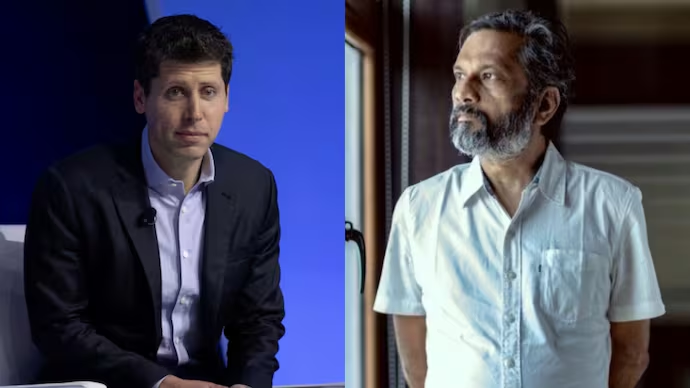
The recent debate between Sam Altman and Sridhar Vembu over intelligence and human energy use shows a bigger global discussion about sustainability, productivity and the true cost of technological progress.
At glance the comparison may seem technical about electricity use and efficiency.. Beneath the surface there is a broader disagreement about how society should evaluate AIs benefits versus its environmental impact.
This discussion is especially relevant now with AI systems like language models being used widely data centers expanding and climate change concerns growing.
Lets explore this debate in detail.
* **Background: The AI Energy Debate**
Artificial intelligence systems, large language models and generative AI tools need significant computational resources. Training these models requires data centers powered by thousands of high-performance GPUs. After training running these systems for millions of users uses a lot of electricity.
In this context Sam Altman argued that comparisons between AI energy use and human energy use need perspective. He suggested that when evaluating AIs energy consumption we should compare it to the energy humans consume to perform similar tasks. Humans need food, infrastructure and biological energy. So the energy cost of AI must be assessed relative to the productivity it delivers.
Sridhar Vembu pushed back strongly. He argued that such comparisons are misleading and oversimplify environmental and economic realities. According to Vembu equating machine energy use with human metabolic consumption ignores ecological and systemic factors.
* **Who Are the Key Figures?**
Sam Altman
* CEO of OpenAI
* One of the leading voices in the global AI revolution
* Advocate for AI deployment and scaling
* Believes AI will significantly increase human productivity
Sridhar Vembu
* Founder of Zoho Corporation
* Known for his rural development initiatives in India
* Strong advocate for decentralized economic growth
* Frequently critiques technological centralization
Their disagreement reflects two different visions of technological progress: rapid scaling versus cautious sustainability.
* **Sam Altman’s Argument: AI as an Energy-Efficient Intelligence**
Altmans argument can be summarized as follows:
Humans consume energy too. Every task humans perform. Writing, calculating, analyzing. Requires calories. Those calories come from food and food production is energy-intensive.
AI can outperform humans in tasks. AI models can write code analyze data and generate content faster than humans.
Per-unit productivity may favor AI. If one AI system can perform the work of thousands of humans the total energy cost per unit of output might be lower.
Technological efficiency improves over time. Hardware becomes more energy-efficient with each generation.
Altmans view fits into a Silicon Valley mindset: technology scales, costs fall and efficiency improves.
* **Sridhar Vembu’s Counterargument: The Flaws in the Comparison**
Vembu challenged the framing itself. His objections include:
1. **Humans Are Not Just “Energy-Consuming Machines”**
Humans do more than produce output. They build communities care for families create culture and maintain cohesion. Comparing biological energy to machine electricity oversimplifies human value.
2. **System-Level vs. Task-Level Comparison**
Humans consume energy whether or not they are working. AI energy consumption is not a replacement for human survival energy. Even if AI performs tasks humans still need to eat, live and consume resources.
Thus AI energy use is not necessarily offsetting human energy use. It is often additive.
3. **Concentration of Power**
Large-scale AI systems require centralized data centers, significant capital investment and control by a few corporations. Vembu has consistently advocated for decentralization. From his perspective AI could increase inequality and environmental stress simultaneously.
* **The Real Numbers: How Much Energy Does AI Use?**
Training a state-of-the-art AI model can consume thousands of megawatt-hours of electricity to the energy used by hundreds of households annually. Inference also consumes energy: each AI query uses electricity than a standard web search and billions of queries multiply the total impact.
However global electricity production is in the tens of thousands of terawatt-hours annually. In this context AI currently accounts for a rapidly growing share.
* **The Broader Context: Data Centers and Climate**
Data centers worldwide are expanding rapidly. Major technology companies are investing heavily in energy contracts, nuclear power partnerships and advanced cooling technologies. Yet concerns remain about water usage for cooling, strain on grids and carbon footprint from fossil-fuel-based electricity.
The debate between Altman and Vembu reflects these trade-offs.
* **Philosophical Differences: Productivity vs. Sustainability**
At its core the disagreement is philosophical.
Altman’s Philosophy: AI will amplify capability economic growth solves many environmental problems and innovation ultimately reduces cost and increases efficiency.
Vembu’s Philosophy: Growth must be sustainable technology should be decentralized and human well-being is not reducible to output metrics.
This difference mirrors standing debates in economics between tech-optimists and ecological economists.
* **Human Energy vs. Machine Energy: A Conceptual Analysis**
Human Energy: Derived from food embedded in systems and part of natural biological cycles.
Machine Energy: Derived from electricity often fossil-fuel-based and concentrated infrastructure.
The environmental impact depends on the source of energy. If AI runs on energy its carbon footprint decreases significantly.
* **Economic Implications**
If AI significantly increases productivity GDP may rise labor demand may. New industries may emerge. However jobs may be displaced energy demand may surge and wealth concentration may increase.
* **India’s Perspective**
In India, where both leaders have influence energy infrastructure is still developing rural electrification remains critical and sustainable growth is essential. Vembu’s rural development model focuses on distributing activity beyond metropolitan hubs. AI data centers by contrast tend to cluster in areas with infrastructure.
* **The Environmental Paradox**
AI can help fight climate change by optimizing logistics improving grid efficiency advancing research and enhancing climate modeling.. Ai also consumes significant electricity.
Thus AI is both part of the problem and part of the solution.
* **Ethical Considerations**
The debate also raises questions: Who benefits from AI? Who bears the cost? Are we accelerating consumption patterns? Should AI deployment be regulated based on energy footprint?
Altman’s approach emphasizes innovation with safeguards. Vembu emphasizes restraint and structural reform.
* **The Future Outlook**
Several trends may shape the outcome: chip efficiency, renewable energy integration, regulation and edge computing. The debate will likely intensify as AI adoption accelerates.
* **Who Is Right?**
The answer may not be binary. Altman is correct that humans consume energy too productivity comparisons matter and technology historically becomes more efficient. Vembu is correct that framing matters AI energy use is additional and sustainability cannot be ignored. Both perspectives highlight truths.
The exchange between Sam Altman and Sridhar Vembu is not merely about electricity consumption. It reflects two competing visions of the future: a future powered by AI-driven productivity growth and a future grounded in sustainability, decentralization and ecological balance.
Artificial intelligence represents one of the transformative technologies of the 21st century.. Like all powerful tools its impact depends on governance, infrastructure and social values.
Ultimately the debate reminds us that technological progress must be measured not in computational efficiency but also in human well-being, environmental sustainability and equitable distribution of benefits.
As AI continues to evolve discussions, like this will shape how responsibly—. How wisely—it is integrated into society.