Daksh Pandey
Realme’s “Pro+” phones have usually meant one thing: the brand throws its best camera tricks, a flashy screen, and a big battery into a price that undercuts obvious rivals. With the Realme 16 Pro+ 5G, that formula is still here—but it’s been refined in three places that matter most to everyday users: camera versatility (especially portraits/zoom), design & durability, and battery endurance.
1) Quick identity check: what the Realme 16 Pro+ is trying to be
The Realme 16 Pro+ sits in the upper mid-range and aims at people who want:
- A premium-looking curved AMOLED with very high refresh rate
- A “main + telephoto” camera combo that feels closer to flagship behavior (especially for portraits)
- A huge 7,000mAh battery that removes daily battery anxiety
- Extras like high durability (IP rating) and fast charging
In India, the phone has been listed/covered at a starting price around ₹39,999.
2) Design upgrade: more premium feel + tougher build than you’d expect
A) Look and in-hand feel
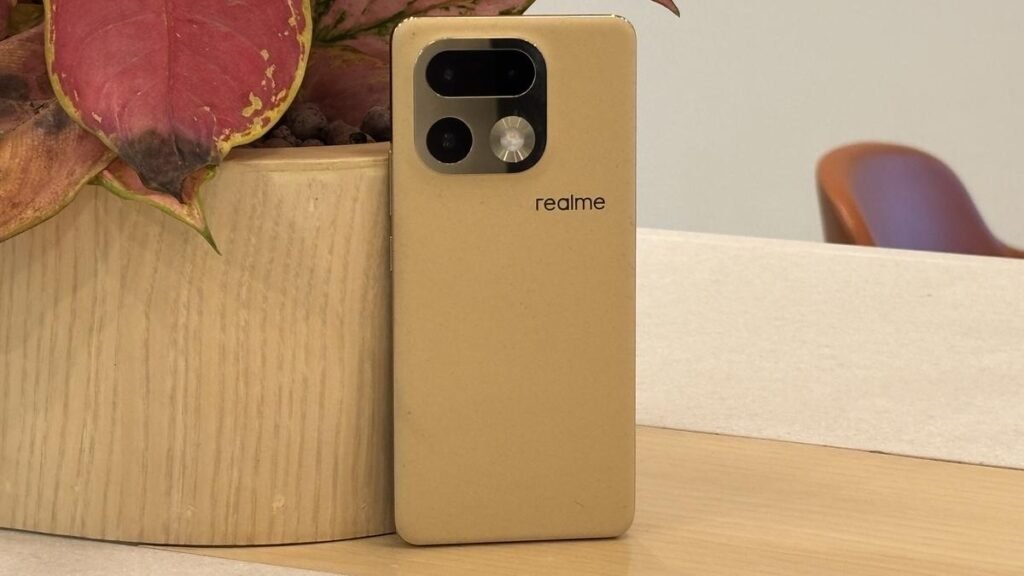
Realme is clearly leaning into a “premium flagship silhouette” this year—especially with the curved display and refined finishing. The phone is shown in multiple colors (including Master Gold, Master Grey, and Camellia Pink).
Curved displays are always a taste thing: some people love the “infinite edge” feel and how it makes the phone look slimmer, while others dislike accidental touches or the slightly trickier screen protector situation. Realme’s goal here is obvious: make the 16 Pro+ look and feel like it costs more than it does.
B) Durability and protection
One of the biggest practical design upgrades is the IP rating. The 16 Pro+ is listed with IP69 water/dust resistance. That’s not just “oops, rain” protection—on paper it’s a high durability spec you don’t always see in this segment.
What it means for you: you can be less precious about using it outdoors, in the kitchen, in monsoon season, at the gym, etc. Just remember: IP ratings reduce risk; they don’t make a phone immortal, and warranty terms still matter.
C) Weight and thickness realities
A big battery and a large screen come with physical consequences. The phone is listed around 203g and about 8.49mm thick.
That’s not unusually heavy for a big-screen, big-battery device, but if you’re coming from a lighter phone, you’ll feel it—especially one-handed.
Verdict on design:
Realme’s design upgrade is not only about aesthetics; it’s also about confidence and durability. A phone that looks premium but feels fragile is frustrating. Here, the combo of curved AMOLED + IP rating + modern finishes gives the 16 Pro+ a stronger “long-term ownership” vibe.
3) Display: one of the biggest reasons to buy this phone
Realme is going hard on the panel, and it shows on the spec sheet:
- 6.8-inch curved display
- 1.5K resolution
- 144Hz refresh rate
- Very high peak brightness (reported up to 6500 nits)
- High-frequency PWM dimming (reported 4608Hz) and 10-bit color
A) Real-world impact: smoothness + visibility
A 144Hz screen isn’t just a gamer flex. It can make everyday scrolling feel “buttery,” especially on well-optimized UI animations. It also makes the phone feel faster than it might be in raw benchmarks, because your eyes register smooth motion as performance.
The brightness claim (6500 nits peak, in specific conditions) matters most for harsh sunlight visibility and HDR highlights.
In daily use, what you’ll notice is: the screen should be punchy outdoors and confident for video.
B) Comfort features
High-frequency PWM dimming can help with perceived flicker at low brightness for some users (this varies by person). Realme highlighting 4608Hz PWM suggests they’re targeting comfort-conscious buyers too.
Verdict on display:
If your top priorities are watching content, reading, scrolling social apps, and gaming, the 16 Pro+ is positioned as a display-first phone in its class. This is one of its clearest “upgrade” areas.
4) Performance: strong mid-range power with modern efficiency goals
Different listings/coverage point to a capable upper-mid chipset (for example, Beebom lists Snapdragon 7 Gen 4).
What that generally translates to in real life:
- Smooth day-to-day performance (social apps, camera, multitasking)
- Better thermals/efficiency than older midrange chips
- Good gaming performance for popular titles (though not “absolute max” like flagship Snapdragon 8-series phones)
The important part: a high-refresh display can expose weak performance quickly—stutters become obvious. Realme’s decision to pair a 144Hz panel with a modern mid-range platform suggests they’re aiming for a consistent feel, not just a spec-sheet number.
5) Camera: the headline upgrade (and why it matters)
Realme is marketing this phone heavily around a camera setup that’s meant to feel more “Pro,” especially for portraits and zoom.
Key highlights shown on the official product page/coverage include:
- 200MP main camera
- A 3.5× telephoto lens
- Emphasis on “full focal portrait” and portrait algorithms (Realme mentions ProDepth bokeh for vibe portraits across focal lengths)
A) Why a telephoto lens is a real upgrade
In this segment, many phones rely on:
- a strong main camera, and
- then “fake zoom” (digital crop) for everything else.
A true telephoto lens (even a moderate 3–3.5×) changes your photography in real ways:
- Portraits look more natural.
Telephoto focal lengths compress the face slightly and reduce distortion—noses don’t look exaggerated, facial proportions look more flattering, and background blur looks more “camera-like.” - You can shoot people from a comfortable distance.
This matters at events, cafés, weddings, and street photography. People behave more naturally when a phone isn’t 30 cm away from their face. - Better detail at zoom ranges you actually use.
Most people live between 2× and 6× for daily zoom shots. A dedicated telephoto improves those ranges dramatically compared to pure digital zoom.
Realme directly pitches the 200MP + 3.5× combo as enabling portraits “across all focal lengths.”
B) The 200MP question: is it real quality or just a number?
A 200MP sensor can be genuinely useful, but not in the “always shoot 200MP” way most people imagine.
Where it helps:
- Pixel-binning (combining pixels) for better light capture
- Cleaner detail in good light
- Cropping flexibility (especially when paired with good processing)
Where it doesn’t magically help:
- Very low light without strong stabilization/processing
- Fast-moving subjects (processing is more important than megapixels here)
- Skin tones and HDR balance (tuning matters more than resolution)
So the “upgrade” you should expect is not “my photos are 4× sharper.” Instead, expect:
- more reliable detail in daylight,
- better portrait options due to the telephoto,
- and improved flexibility when framing.
C) Portraits: Realme’s big bet
Realme’s marketing language (“vibe portraits,” “full focal portrait”) strongly suggests they’ve put effort into subject detection and background separation, and into consistent portrait output at different zoom levels.
If Realme’s processing is tuned well, this can be one of those phones that makes people say:
“Wait, you shot that on a mid-range phone?”
D) What to watch out for (common Realme camera trade-offs)
Even with upgrades, there are typical mid-range camera pitfalls you should keep in mind:
- Skin smoothing / beautification defaults: often aggressive unless you tweak settings.
- Over-sharpening in daylight: can make hair/edges look “crispy.”
- Low-light consistency: can vary between main and telephoto lenses, because telephoto sensors are often smaller and struggle more at night.
- Video stability and HDR: sometimes less polished than top flagships.
None of these are dealbreakers, but they’re the kind of differences you notice if you compare against premium flagship camera phones.
Verdict on camera:
This looks like a meaningful upgrade because it’s not just “more megapixels.” The addition of a telephoto lens alongside a high-res main camera is the kind of choice that actually improves daily photography—especially portraits and event shots.
6) Battery: the most practical upgrade of all (7,000mAh)
If you’ve ever owned a phone where battery anxiety shapes your day—carrying a power bank, switching off features, hunting for chargers—then this is the part that matters most.
The Realme 16 Pro+ is listed with a 7,000mAh battery and 80W fast charging.
A) What 7,000mAh means in real life
A battery this size usually translates to:
- Easy one-day use even with heavy usage (camera, 5G, high brightness)
- Potential 1.5–2 days for moderate users (depending on apps and signal strength)
- Less stress about battery health long-term, because you’re not draining it to zero daily
One early review-style piece notes that once charged, the phone can deliver over a day under moderate to heavy usage and cites around ~11 hours of screen-on time as an expectation in typical conditions.
B) Charging: fast enough to make the big battery convenient
A huge battery is only half the story. If charging is slow, you still suffer.
Realme lists 80W Ultra Charge support and compatibility with common charging standards (like PPS/PD at certain levels).
This means top-ups should be practical, and you’re not trapped at the wall for ages.
C) The “big battery + big screen” balance
A 6.8-inch high-refresh OLED can be power-hungry, especially at 144Hz and high brightness. That’s exactly why 7,000mAh is such a smart pairing—it’s designed to keep the experience “maxed out” without punishing you later.
Verdict on battery:
This is one of the phone’s biggest, clearest wins. If battery life is a top-3 priority, the Realme 16 Pro+ is built to be a comfort phone: use it hard, stop worrying.
7) Software: Android 16 + Realme UI, with an AI push
Coverage of the series mentions Android 16-based Realme UI (UI 7.0) and Realme’s broader AI ecosystem push.
What to expect (generally) from Realme UI in this segment:
- A feature-rich UI with lots of customization
- Useful quality-of-life tools (sidebar, smart gestures, gaming tools)
- Some preinstalled apps (how “clean” it feels depends on region/variant and what you uninstall)
If you like tweaking your phone to feel “yours,” Realme UI usually gives you plenty to play with. If you prefer Pixel-like minimalism, you may need 20 minutes of setup to disable/remove extras.
8) Connectivity and daily hardware essentials
From listings/spec pages and general coverage, you’re getting:
- 5G support (multi-band support listed on spec aggregators)
- Modern biometrics (in-display fingerprint + face unlock listed on Realme specs pages)
- Dual SIM support (common for India)
Also, the presence of an IP rating at this level is a quality-of-life benefit that’s easy to underestimate until you’ve lived with it.
9) Value and positioning: who should buy it?
At around ₹39,999 starting price in India, this phone tries to justify itself with three “expensive-feeling” upgrades:
- Camera versatility (200MP + a real telephoto for portraits/zoom)
- A top-tier display experience (144Hz, high brightness, premium curve)
- Battery dominance (7,000mAh + 80W)
Buy the Realme 16 Pro+ if:
- You take a lot of portraits, people photos, and event shots, and want better zoom than typical mid-range phones.
- You care about a premium display and scroll/gaming smoothness.
- You want a phone that’s stress-free for battery.
- You value durability (IP rating) and a premium look.
You might skip it if:
- You hate curved displays and prefer flat screens.
- You want the absolute best low-light camera or flagship-grade video (you may need to look higher up the price ladder).
- You prefer very clean software with minimal bloat and minimal tweaking.
10) Pros and cons summary
Pros
- Excellent battery proposition: 7,000mAh + 80W fast charging
- More “serious” camera setup with 200MP main + 3.5× telephoto for portraits/zoom
- High-end display specs: large 6.8″ 1.5K curved, 144Hz, very high brightness claim
- Strong durability on paper with IP69 rating
- Premium design direction, modern flagship-like feel
Cons / trade-offs
- Curved display may be polarizing (accidental touches, protector choices)
- Big battery + big screen means noticeable weight
- Camera processing style may not match everyone’s taste (you may need to tweak settings for more natural output)
- At ₹40k, competition is intense—value depends on whether you truly want the camera + battery combo