Daksh Pandey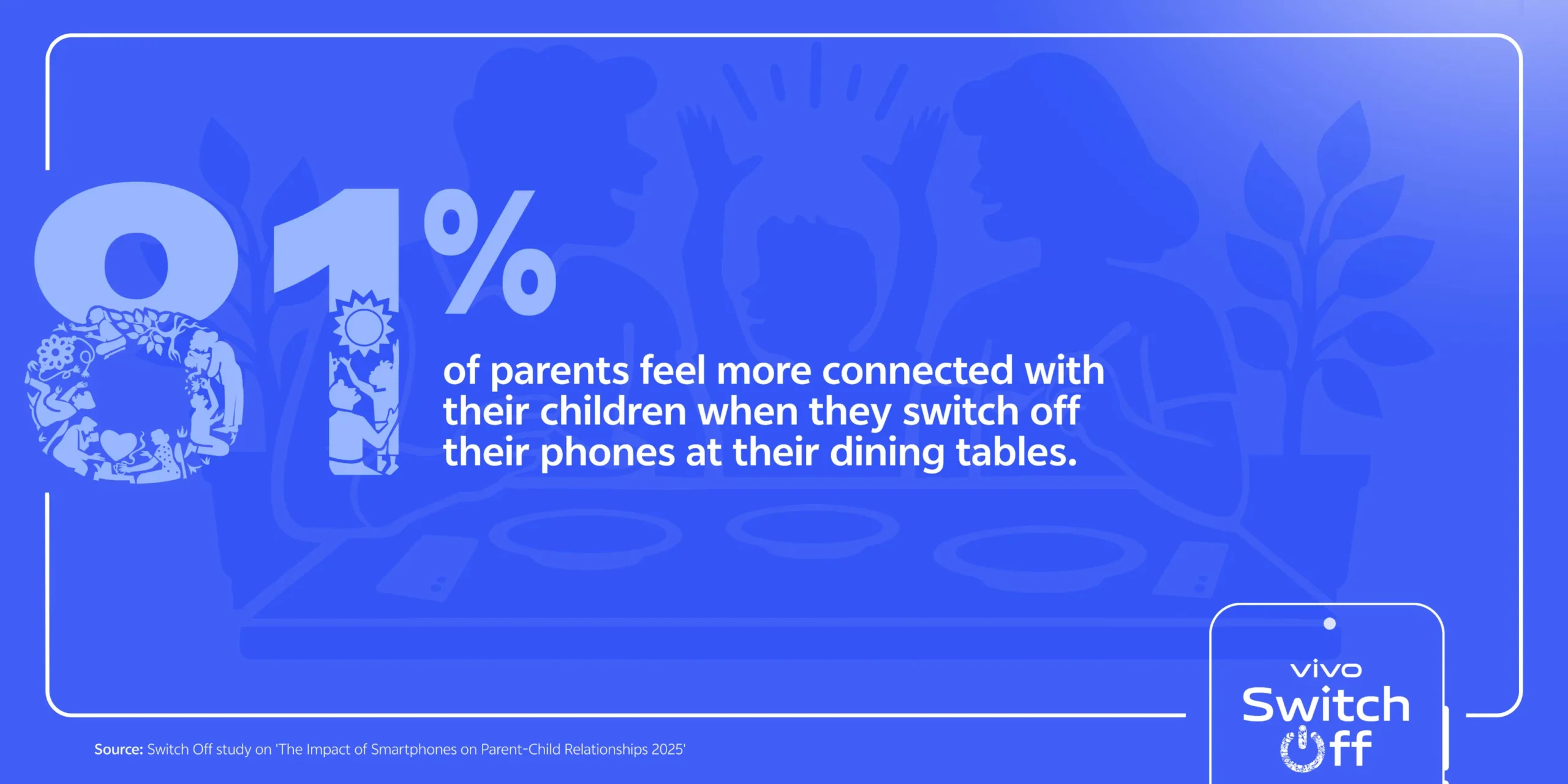
A dining table is supposed to be one of the few places in a busy Indian home where everyone’s day finally slows down. It’s the moment when school, office tuition, traffic, deadlines, and notifications take a back seat—at least in theory. But in reality, many families now sit together with their attention remaining scattered across screens: one scrolling reels, another typing out that work message, someone watching highlights, and someone else half-listening while typing.
That’s literally the tension behind the vivo Switch Off Study 2025-a research report focused on the impact of excessive smartphone usage on parent-child relationships. The headline idea is simple: Indian families are not rejecting technology-but they increasingly yearn for phone-free “rituals” during the moments that matter most, especially at dinner time.
This explanation breaks down what the study says, why dinner tables are becoming the new battleground for attention, what it reveals about parents and children, and how families can turn this insight into practical daily habits.
1) What is the vivo Switch Off Study 2025?
The Switch Off Study 2025 is the seventh in a series of annual research by vivo into the use of smartphones more mindfully and its impacts on relationships, this time zooming in strongly on parent-child interaction and daily bonding.
Who conducted it and how?
The report goes on to say, with associated write-ups:
The survey is a quantitative study covering 1,517 smartphone owners: 1,017 parents and 500 children across 8 major Indian cities, namely New Delhi, Mumbai, Kolkata, Chennai, Hyderabad, Bengaluru, Ahmedabad, Pune.
A qualitative follow-up included 18 participants-12 parents and 6 children-in New Delhi and Mumbai to add depth to the numbers.
Business media coverage attributes the research partnership to CyberMedia Research, CMR.
So this isn’t just one opinion poll-it’s framed as a broader urban study (major cities) plus deeper interviews for context. Like most brand-commissioned studies, it ought to be read thoughtfully: real patterns are highlighted; it is also designed to support a public campaign message, #SwitchOff in this case.
2) The big headline: Dinner is the strongest daily bonding window
The most frequent and, therefore, most striking finding concerns dinner time.
Why just dinner?
Well, because dinner is one of the last “automatic together moments” left in many homes. Even if the rest of the day is fragmented—parents in meetings, kids in school or coaching—dinner still tends to bring people into one physical space at one time.
This is what the report points out:
72% of kids report that they spend the most time with their parents at dinner time.
That makes dinner a natural opportunity for connection. And that’s why phone intrusion at the table becomes such a big deal: it doesn’t just interrupt a random moment; it interrupts the moment that’s most likely to be shared in the first place.
- What happens when phones are kept away?
The report doesn’t just say, “Phones distract.” It measures what families say changes when phones are put aside.
Children feel conversations become easier and more meaningful.
The strongest numbers among them are:
91% of children say it’s easier to talk when phones are put away.
And the report presents this as not merely “less distraction” – but a different emotive atmosphere: when the phone isn’t there, the child feels fuller attention, fewer interruptions, and a more relaxed space to speak.
Parents also feel that there is better bonding.
The study and related coverage note: “Many parents reported stronger bonding during phone-free meals.
Parents’ perspective reported in campaign coverage: 81% of parents notice stronger bonding when digital distractions are removed from the dinner table.
“Phone-free zones” inside homes
The report also mentions where the families prefer to see phone-free behavior. It is the dining table that clearly stands out:
It says there is increased interest in placing the dining table off limits to the phone and illustrates a strong preference for phone-free dining tables.
It is important because that signals something deeper than “reduce screen time.” The indications are that what families want is a goal like “don’t use phones in certain places and during certain rituals where being present needs to be a default.
- The problem is not just kids—parents’ “micro-checking” is a major culprit
The stereotype goes something like: kids are addicts of phones, parents are responsible.
But the Switch Off Study flips that narrative in a more uncomfortable-and probably more accurate-direction.
Framing of the report across write-ups: Parents slip into habitual checking – work notifications, quick WhatsApp replies, “just one email”, “just one scroll”. It is not always entertainment; it is often “responsibility” and “stress”.
And yet, from a child’s vantage point, the why doesn’t matter much. It is the signal conveyed:
It means that though physically present, one’s attention is elsewhere.
Why micro-checking hurts more than long usage
Paradoxically, micro-checking does more damage to conversation than long phone use at separate times. Why?
It cuts the flow of talk mid-sentence.
This will naturally force the child to compete with the screen for attention.
It makes the child feel like their message is “less urgent” than a notification.
This is why the study’s focus on dinner is smart: it’s at dinner where micro-checking becomes emotionally visible.
5) The “AI turn”: children seeking advice from AI when parents feel busy
One of the most discussed parts of the 2025 report, besides being about phones, is about what fills in the gap when conversation is not happening.
According to the coverage of the report by Business Today:
67% of the children reported turning to artificial intelligence tools due to their feeling that their parents were too busy.
That is a striking statistic, because it tells us the issue isn’t just “too much screen time.” It is unmet emotional availability.
When the child feels:
“My question will upset my parent,” or
“My parent is always busy,” or
“I am going to be interrupted,
…then an AI tool becomes appealing because it is:
always at hand
non-judgmental
responsive
patient, or at least that’s how one may perceive him
Not automatically meaning “AI is bad,” but AI has just become the default listener when humans feel absent.
6) Why phone-free dinners work: the psychology of attention and safety
To understand why dinner is so powerful, it helps to think in terms of attention and psychological safety.
A) Attention is the real currency of relationships.
Love comes in so many ways—through care, money, sacrifice—but perhaps day-to-day bonding is often most clearly expressed by:
Eye contact
to listen without interrupting
remembering details
emotionally react
Phones disrupt all four. Even if the phone is “for work,” the relationship impact can be the same.
B) Children talk when they feel “safe”
Children and adolescents will very often select whether or not to speak based on how safe it feels rather than on the importance of the topic.
Dinner can feel safer because:
the setting is familiar and routine
it’s a shared activity-eating-that is pressure-releasing
conversation can be casual, not an “interrogation”
Safety increases when the phone disappears.
C) Rituals beat willpower
The ritual idea keeps resurfacing-the notion of things one does repeatedly because they do not have to be negotiated every day.
Because the truth is: willpower fails at 9 PM when you’re exhausted. Rituals don’t. If the family rule is “phones stay away during dinner,” then it becomes automatic over time.
7) What the message is attempting to accomplish from the campaign message
It is tied to vivo’s #SwitchOff 2025 campaign, which moves the message right to the dining table. The creative theme highlighted herein is that “the loudest dining tables are the happiest”—meaning, noise, chatter, and laughter are signs of connection and not “disturbance.”
This is a brilliant reframe for Indian homes because the attribute of a “good child” for so many parents is quietness. The campaign says the exact opposite: the goal isn’t silent obedience; the goal is warm conversation.
- Practical Lessons for Indian Families (based on direction provided by the report)
You requested some explanation-so here are the main points put into practical, useful action.
1) Create a “phone parking” spot near the dining area
Arrange a shelf or a small box where everybody puts their phones before sitting.
Why it works:
It removes temptation.
it prevents “I just kept it on the table”
it makes the rule more visible and equal for everybody
- Start small: 3 dinners a week, not 7
When it becomes an all-of-a-sudden declaration of a family – “phone-free dinner every day”-it always fails. Begin with a realistic target:
Mon/Wed/Sat phone-free dinner
Then expand.
Consistency beats intensity.
3) Parents go first-importantly
If kids are told, “Keep your phones away,” and parents keep checking, then that is plainly read as hypocrisy by the children. The framing of the study about parents’ checking being a “conversation killer” renders that point inescapable.
A simple promise from one’s parents helps
“I am not going to use my phone during dinner. If it rings, I will call back after 20 minutes.”
4) Replace phone-time with “conversation prompts”
Some families are quiet at dinner not because phones exist, but because they don’t know what to talk about. Try prompts like:
“Best moment of your day?”
“Most irritating moment today?”
“One thing you learned?”
“If you could change one thing about today, what would it be?”
Keep it light. Do not make dinner into an exam.
- Don’t make it only about “discipline”-make it about joy
If dinner without phones becomes a punishment, kids will rebel.
In case that becomes:
jokes
stories
Family updates
fun debates
…they’ll defend it themselves.
That aligns with the campaign’s emotional angle: taking back the “happy noise” of the table.
9) Takeaway for schools and communities
It also suggests that families seek wider support mechanisms, as it becomes more difficult to set home rules when the surrounding environment continuously pulls children online.
For instance, it includes when children support the efforts for phone-free school, as seen in the report text below.
Even beyond that specific point, the broader implication is:
If schools normalize device boundaries, families can enforce them without feeling like they’re isolating their child.
Community agreements, such as those among apartment societies or friend groups and parents, can also help:
“No phone to kids during the first hour of playtime.”
“All parents keep phones away during weekend group lunches.”
10) A balanced view: phones aren’t “evil”—mindless use is the real problem
A mature reading of the Switch Off Study is not “throw phones away.” The report frames the goal again and again as balance and mindful use: technology should enhance family life, not replace presence.
Smartphones are actually helpful:
Learning, navigation, safety, staying in touch.
But the warning is when a phone becomes the default companion during the only shared family window, it comes at a relationship cost.
11) The deeper message: children don’t need less screen time, they want more “availability” The most powerful takeaway is not the dinner statistic. It’s what the dinner statistic means: Children talk more when they feel seen. They look for alternatives-temperate or otherwise, including AI-when they are feeling starved of attention and parents appear “too busy.” So a reminder, really, of what the report said, which is that connection is not created by grand events-vacations, birthdays, expensive gifts. It’s created by small daily rituals-especially the ones that protect attention. Conclusion: why this matters in 2025 In 2025, phones aren’t “devices we use.” They’re environments we live inside: work, entertainment, friends, news, shopping, even advice from AI. The vivo Switch Off Study 2025 underlines how Indian families are now actively making an attempt to reclaim at least one everyday space from that environment-the dinner table. The core message of this study is a simple yet strong reminder that Real relationships need more presence, not time.