Daksh Pandey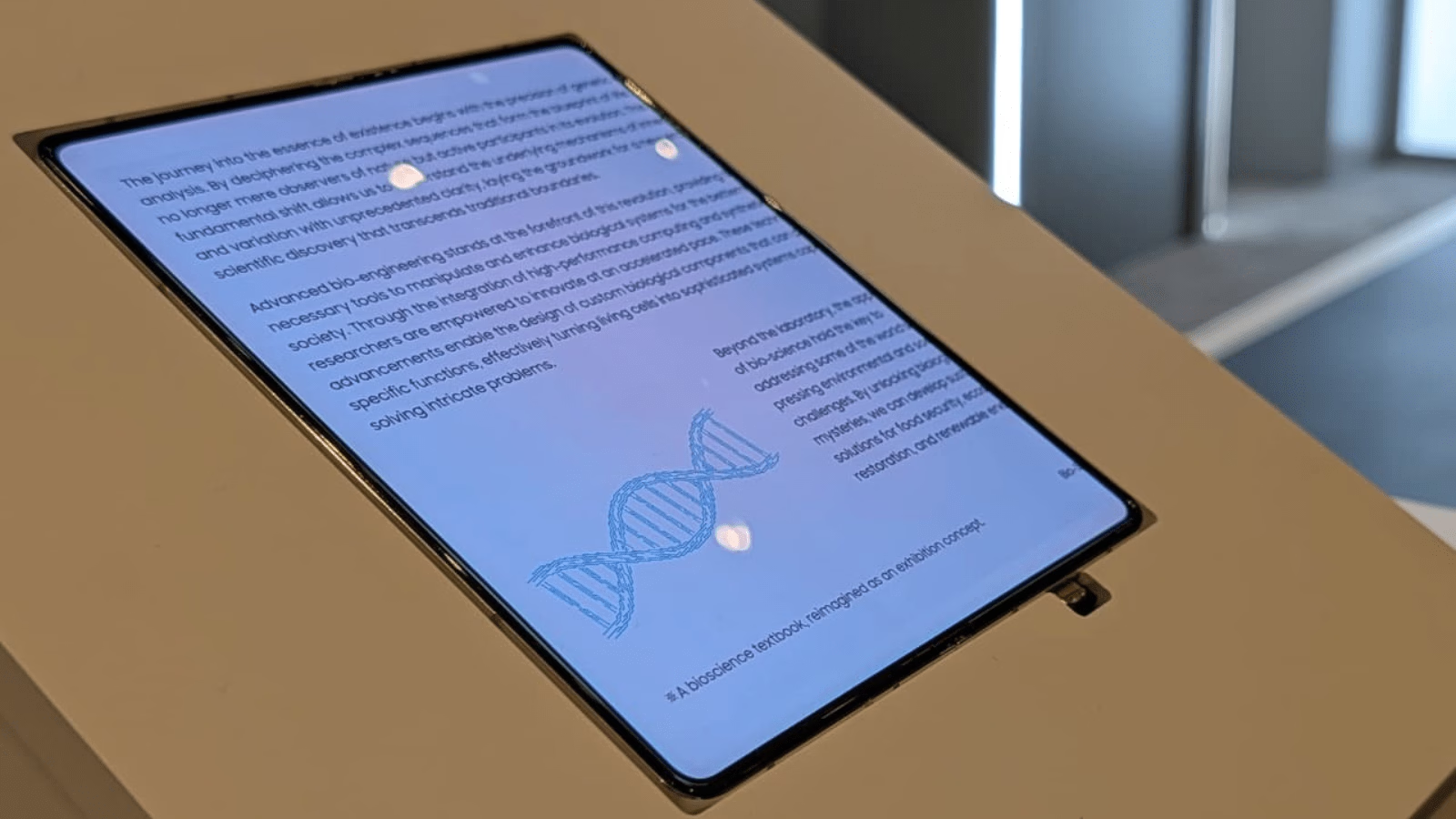
Apple has been watching other companies make phones for a long time. They have seen companies like Samsung try things and make their foldable phones better. Samsung has been working on making the hinges stronger the glass thinner and the software more user friendly. They have also been trying to make the crease in the phone less noticeable.
Now people are talking about Apple making an iPhone maybe in 2026 or 2027. The interesting thing about this is not that Apple is finally making a foldable iPhone. It is how Apple is going to make an iPhone that does not have a big crease, in it. Apple wants to make an iPhone with a near crease-free experience, which means the iPhone Fold will look like a regular phone when it is opened up.
People are saying that Apple might work with Samsung Display to use their foldable OLED technology. This is the technology that Samsung Display showed off at CES 2026. They compared it to foldable screens and it looked a lot better.. What does it mean when we say Apple is turning to Samsung? It does not mean that Apple just buys a screen, from Samsung and puts it in an iPhone. Apple and Samsung Display have to work to make this happen. Samsung Display makes the screens. Apple has to make sure they work well with the iPhone. Apple usually wants things made for them like special materials and testing. So the story is not that Apple will just copy Samsungs screen that does not have a crease. It is more that Apple may use the fact that Samsung’s good at making things to get what Apple wants which is a design that is unique, to Apple products.
Let us take a look at what is being reported. The fold, in the screen is a tough problem to solve. We want to know why this is the case. What did Samsung Display probably show off at the CES event? What does this mean for Apples iPhone that you can fold up?
Why the crease is the boss fight of foldables
A crease exists because a foldable OLED is not one flexible piece. It is made up of layers. A foldable OLED is a system, with many parts that are stacked on top of each other. This is why a foldable OLED has a crease.
The OLED emissive layers, which are the parts that make light in the OLED are really important for the OLED to work properly. The OLED emissive layers are what make the OLED produce light.
Touch sensing layers
There are layers that help keep oxygen and moisture out. These layers are really good at keeping things fresh by stopping air and water from getting in. Encapsulation layers do a job of this. They work well to keep oxygen and moisture out. This helps to keep things from getting damaged. Encapsulation layers are very useful, for this purpose.
Adhesives
A protective top layer (often ultra-thin glass, plus coatings)
Mechanical reinforcement layers and/or plates beneath
The hinge system is really important because it controls how much the bend radius is. This bend radius is the distance that something can bend before it gets damaged. The hinge system helps to make sure that the bend radius is just right.
So when we talk about the hinge system that controls the bend radius we are talking about the hinge system and the bend radius together. The hinge system and the bend radius are very important, for things that need to bend, like pipes or wires. The hinge system that controls the bend radius has to be strong and work well.
The hinge system that controls the bend radius is used in things like machines and buildings. It helps to keep the bend radius safe and makes sure that things do not get broken. The hinge system and the bend radius are a team. They work together to make things work properly. The hinge system that controls the bend radius is an useful thing.
Every time you fold something you are making this stack bend over and again in one particular spot. If this bending puts much stress in that one spot you get:
A visible “valley” or “ridge”
Light distortion along the fold line
Touch irregularities
The thing about screens is that they can get really tired over time. This long-term fatigue can cause problems like cracks or issues with the pixels, on the screen. When we talk about long-term fatigue we mean that it happens after using the screen for a long time. This kind of long-term fatigue can lead to cracks or pixel issues on the screen.
So a crease is not about how it looks. A crease is a sign that the stack of papers is bending in a way that’s not even and the stack is feeling too much stress in one area. The crease shows that the stack is experiencing a -uniform bend and this is causing stress concentration, on the stack.
So the main goal is to make sure the stress is spread out over an area of the device or to make the curve of the device a lot gentler. The device needs to be thin and strong, at the time. It also has to be easy to make a lot of these devices. The device has to be durable. It has to be thin all while being easy to make in large quantities. This is what people mean by the holy grail of the device. The holy grail is to get all these things right so the device is thin and durable and can be made at scale which means making a lot of them.
So I was reading about what Samsung Display showed off at the CES 2026 event.
* They had some cool stuff on display.
Samsung Display had a lot of people talking about the things they brought to CES 2026.
I think Samsung Display is trying to change the way we think about screens and Samsung Display is doing some amazing things.
Samsung Display is going to be a player in the tech world and what Samsung Display did, at CES 2026 is just the beginning.
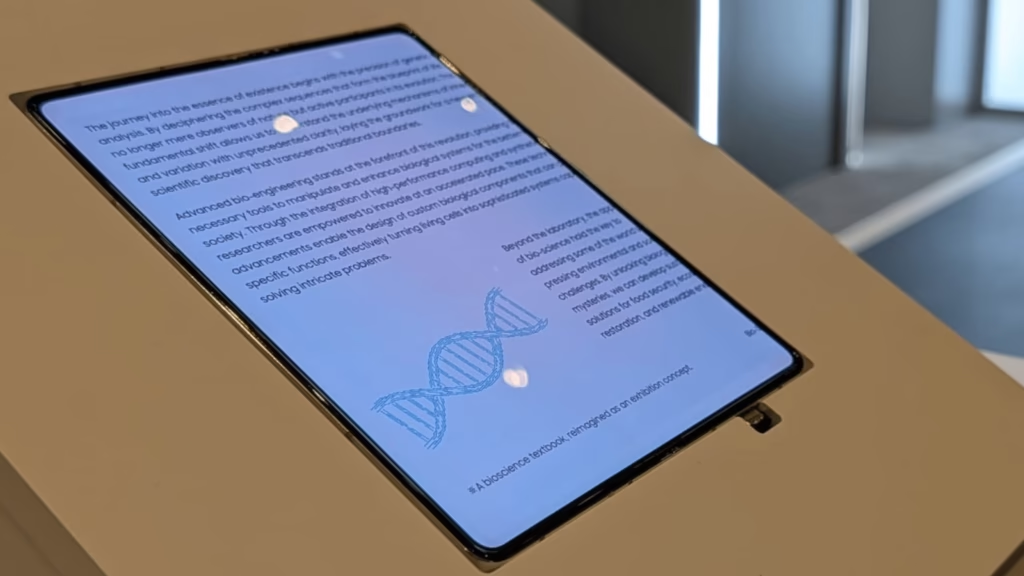
People are talking about what Samsung Display did at CES 2026. They showed a kind of foldable screen that is almost completely flat. This screen is made with technology. Some people said it looked like there was no line or crease on the Samsung Display OLED screen at all. This is really different, from the screens we have now. The new Samsung Display foldable OLED screen is an improvement.
Some things that kept coming up in the stories, about the topic are:
The demo was set up to compare it directly to a screen that already exists, like the Galaxy Z Fold model. They put the demo next, to the Galaxy Z Fold model so people could see how it stacks up.
Some people are saying that the display will also have a camera underneath it. This is an idea that the company is trying out with the display it is not something that you will definitely see in the final product it is more, like something they are showing off to see what people think of the technology.
People are talking about a test area that was seen and then taken away. On it was said that this test area had been shown to several groups before that. The test booth was seen by some people. Then it was removed. The test booth had been shown to groups earlier.
For Apple the thing that really matters is not what happens at the booth it is what it means. Samsung Display is showing that they can make screens where the line in the middle’s not a problem when you are looking at it normally. This is what is important for Apple. Samsung Display is saying they can make these screens and that is a deal. The line, in the middle of the screen, which is called a crease is not something you notice when you are using the screen like you normally would. This is what Samsung Display is trying to say.
When we talk about “Samsung” here we are referring to “Samsung” Display, not the part of “Samsung” that makes phones.
This part is really important. It gets confusing when people talk about it on the internet.
Samsung Display is a company that makes parts for companies. They make something called panels. A lot of brands use these OLED panels. For example the iPhone uses OLED panels made by Samsung Display. So Samsung Display is very important, for making these OLED panels that many brands use, including the iPhone.
Samsung MX (Mobile Experience): Samsung’s phone division (Galaxy devices).
People are saying that Samsung Mobile and Apple might use ways to make their products stronger. This is interesting because both companies use the panels made by Samsung Display. There is a rumor going around that the special panel technology Samsung is using for its foldable phones will not be the same as what Apple is using. The reason, for this is that the materials used to make them strong are different. Samsung is using a metal plate. Apple might be using glass or something called UTG. This means that Samsung Mobile and Apple are taking approaches even though they are both working with Samsung Display.
So the more realistic picture is:
Apple is thinking about buying screens from Samsung Display. These screens are really cool because they can fold. They are also made with something called OLED. Apple wants to get these screens from Samsung Display because they make ones. Apple needs these screens so they can make their products with them. Samsung Display will be like a helper, to Apple giving them the screens they need.
The panel. The reinforcement strategy could be specific to Apple products. The panel stack and reinforcement strategy might be something that only Apple uses. This means the panel stack and reinforcement strategy could be different, from what other companies use.
To get rid of a crease you have an options. The main things that engineers do to reduce a crease are
* change the way something is made
* use materials to make it
* try to make the thing stronger so it does not get creased easily
The main engineering things that help reduce a crease are really important. Reducing a crease can be a problem and engineers have to think of ways to do it. They use the engineering levers to make it happen. Reducing a crease is what they want to do. They use the main engineering levers to get it done.
So you want to reduce creases. Think of crease reduction as a problem, with things to consider. You can make crease reduction better by changing a things:
1) Bend radius (hinge geometry)
A hinge can make a phone fold in a shape that looks like a waterdrop or a teardrop. This is different from a fold.
When the radius of the hinge is bigger it helps to reduce the stress on the phone. The fold is not as deep.. It can also make the phone a little thicker. The phone, with a radius hinge will have a waterdrop or teardrop-shaped fold.
Apple is trying out things with hinges. They want to make the hinges stronger and better. This is so that when you fold something it does not get damaged easily. Apple wants to use strong materials and make sure everything is working perfectly. Some people are even talking about using something called ” metal” for the hinges. The goal is to make the folding work and you do not see any damage, to Apple products when you fold them.
2) The reinforcement plate / backplate
When we look at the OLED stack the people who make these things use plates or support layers to deal with stress. There are some reports that say Samsung showed off a idea at CES that used a metal backing, at least in one version. On the hand Apple might like to use a glass-based way to make the OLED stack stronger. The OLED stack is really important here because it needs to be able to handle the stress and that is why the OLED stack is managed with these support layers.
3) Let us talk about -thin glass and how ultra-thin glass is used. Ultra-thin glass is really thin. That is why it is called ultra-thin glass. People use -thin glass in many things because ultra-thin glass is very thin. The way ultra-thin glass is applied is very important when we use -thin glass.
UTG has become an important part of making high end foldable devices. The UTG is still very thin. It needs to have special coatings on it but when you touch it the UTG feels more like real glass than the old surfaces that were only made of plastic. The UTG is what makes these devices feel nicer to use.
There are some reports about Samsung Displays next plan. They are talking about using a dual-UTG structure. This means they will put the UTG in than one layer. People think this will make the crease on the screen less visible. It should be 20 percent better, than the old version. Samsung Display is trying to make this work with their next-gen approach. The idea is to use the dual-UTG structure to improve the screen. This is what the reports are saying about Samsung Displays plan.
The exact percentage might be different depending on how we measure it. One thing is clear: using more advanced UTG integration can really help make the fold region smoother. UTG integration is the key, to making this work and with more sophisticated UTG integration we can get a more even result in the fold region.
4) Adhesives and layer bonding
The glue is not fancy. It is really important. The way the layers stick together is crucial because it affects how the forces act on it when you bend it. For example Samsung has this idea called the “MONT Flex Display” where they talk about reducing the creases by using glue. The way they apply the glue makes a difference in how the display holds up when it is bent. The glue is what holds everything together. It is really everything when it comes to the “MONT Flex Display” concept, from Samsung.
5) Thickness and stiffness tradeoffs
A thicker stack can cover up problems with the shape better. It makes the thing bigger. Apple really does not like it when things get too thick which is why a lot of people think Apple has waited until it can get the size right, for Apple.
thinness
rigidity when open
battery volume
durability targets
So Apple might actually turn to Samsung for some reason. The thing is, Apple and Samsung are like two companies that make phones and other stuff. Apple might turn to Samsung because they need something from them. It is possible that Apple wants to use something that Samsung’s good, at making.
* Apple is a company that makes iPhones and other things
* Samsung is also a company that makes phones and other things
* Apple might need something that Samsung has so they might turn to Samsung for help. Apple turning to Samsung is a deal because Apple and Samsung are usually competitors. Apple and Samsung compete with each other to make the phones and other things.. Now Apple might turn to Samsung because they need their help. Apple turning to Samsung is interesting because it shows that even big competitors can work together sometimes.
Even if Apple wanted to make everything by itself it would still need a company that makes displays to work with this company would have to do things like:
High-yield foldable OLED manufacturing
Scale capacity (millions of panels)
Proven reliability testing
Ability to customize (Apple’s #1 demand)
Strong supply chain control for materials like UTG, adhesives, and encapsulation
Samsung Display is seen by people as the best company for making big foldable OLED screens. This is because Samsung Display has been making these screens for a time and has learned a lot from doing so. It has made screens for its own company and for other companies too. Samsung Display has a lot of experience, with OLED screens.
That is why many people think Samsung Display will be the company that makes screens for Apples new foldable phone. This is what a lot of reports are saying. Other companies, like LG Display might also be involved,. Samsung Display seems to be the one that people are talking about the most when it comes to Apples foldable phone. Apples foldable phone is what everyone is waiting for. Samsung Display is likely to play a big role in it.
To make a foldable screen Apple needs to buy from the company that makes the best foldable screens. This company is very experienced. Makes great screens. If Apple buys from them they can make the screen the way they want it to be. This is the way for Apple to get a good foldable screen that does not feel like a new and untested product. Apple wants a screen that is really good so buying from the best foldable OLED maker is a good idea.
The main thing to consider is that Apple might not use the same kind of screen that was shown at CES, the one that they called “crease-less”. Apple may not use this type of screen. The screen that was shown at CES was special because it did not have a crease. Apple might do something different. Apple may decide to use a kind of screen not the exact “crease-less” panel that was seen at CES.
Some people think the idea of a phone, with no crease, which was shown at CES might be something Samsung will use in one of their phones like a new Galaxy Z Fold. Apple might do things differently though. Use different materials to make their phone.
That might sound like a disappointment. It is actually normal.
Apple’s playbook is typically:
Take something that helps make other things work, like a technology that’s already out there and exists. This technology can be used to make things or to improve things that we already have. Take this enabling technology that exists.
I want a version that is exactly what Apple needs a customized version that meets Apples targets.
The company will not send out the products until they are sure that the yields and the reliability of these products are going to be good and consistent. They want to see yields and reliability.
So “Apple using Samsung crease- tech” could mean that Apple is using the technology that Samsung has to make sure that their products do not have any creases. This is a deal for Apple because they want their products to look good and work well.
* Apple is trying to make their products better by using Samsung technology
* This technology helps get rid of the creases on the products
The technology that Samsung has is really good at making sure that products do not get creases. Apple wants to use this technology to make their products the best they can be. Apple using Samsung crease- tech is a big step, for Apple.
Samsung Display is really good at making OLED screens and they actually make them too. They have the skills that are needed for this kind of work. Samsung Display is the one that provides the OLED expertise and they do the manufacturing, for it.
Apple says what they want for a stack. This includes things like UTG choices and thickness targets and also touch integration. Apple wants all these things to work together in this stack. The stack is important for Apple. They have specific ideas, about how it should be set up including the UTG choices and the thickness targets and the touch integration that Apple wants.
Apple pairs the product with its special hinge and the way the chassis is made Apple makes these decisions, about the hinge and the chassis.
and the end result is “crease-free enough” under real-world use.
MacRumors is telling us about the Apple iPhone that can fold. This Apple foldable iPhone is going to have a screen made by Samsung. The Apple iPhone will be thinner because the touch sensors are built into the screen. This means the Apple iPhone will not be as thick, as phones.
So you want to know what an iPhone Fold with no crease would have to do.
This new iPhone Fold is a deal and it needs to get a lot of things right.
It has to make sure the screen is really good and people like using it.
The iPhone Fold has to be able to fold and unfold times without getting a crease in the screen.
* It needs a screen that can handle being folded
* It has to be easy to use when it is folded and when it is not folded.
The iPhone Fold also has to be able to run all the apps people like to use on their iPhone.
If the iPhone Fold can do all these things it will be a great product.
The iPhone Fold is a kind of iPhone and it has to be good, at everything it does.
So Apple needs to get the fold on a foldable iPhone.. It is not just, about that. The whole experience of using an iPhone is what really matters. Here are the important things that Apple will probably pay attention to:
1) Open-state rigidity and “iPad mini vibes”
People put up with a crease, on their screen because it means they get a screen.. If the screen feels soft and squishy or like it is going to break when you open it that is a problem. A screen that feels like that does not feel like a premium screen. The screen is supposed to be a part of the device so when it feels cheap it is annoying. People want a screen but they also want the screen to feel strong and sturdy like a premium screen should feel. If the screen feels fragile when it is open that is not what people want from a device and its big screen.
A stronger reinforcement strategy (UTG enhancements, better support plates) matters as much as crease cosmetics.
2) Longevity: 2–3 years of heavy folding without drama
Foldable phones are getting better. People are still worried about how long they will last. This is especially true for kinds of foldable phones like the ones that fold three times. There have been some stories about foldable screens breaking and being really expensive to fix. This shows that people are very sensitive about this issue, with phones.
Apple will want to avoid any story that says its first foldable phone is easily broken or a headache to fix. Apple does not want people to think that the Apple foldable phone is delicate or that it will be a nightmare to repair the Apple phone.
3) Thickness and weight
If Apple decides to go with a book style fold, like the kind you see on Fold phones then Apple must keep the following things in mind. Apple has to make sure that the Apple phone with a fold, like that is going to work. The Apple phone is what Apple needs to focus on.
* Apple needs to think about how the Apple phone will look when it is folded up
* Apple has to consider what the Apple phone will be like when you open it and use it
The Apple phone with a book style fold is what Apple is thinking about. Apple wants the Apple phone to be something that people will like.
closed thickness reasonable
The thing that is really important, to me is that my weight is balanced. I want to make sure that my weight is balanced so I can feel good. Weight balanced is what I am looking for.
hinge compact
People are talking about materials being used, like frames made of titanium when they discuss this topic though nobody has confirmed this information yet. The exotic materials are really what get people excited and the titanium framing is one example of these materials that people are talking about.
4) iOS and app behaviors on a folding screen
Hardware is half of what makes something good. The best foldable phones feel really natural because the user interface works smoothly on all parts of the phone like when you’re using it. This is because the user interface adapts easily across:
outer display
inner display
split-screen multitasking
continuity when opening/closing
Apple has an advantage because they are in control of the iOS system. This is a thing but it also means that people expect a lot from Apple. If Apple makes a phone people will expect that the apps will switch really smoothly. They will want the experience in the whole industry when it comes to Apples foldable phone and the iOS system. Apples control, over the iOS system is what makes people think that they can do this.
5) Battery and thermals
If you have an inner screen it is going to use more power. So Apple needs to make sure the battery can handle this without making the device really thick. Apple also has to figure out how to manage the heat that is produced by the device. This is not easy because the device has moving parts and lots of different materials, in the screen.
Why this matters beyond one product: the supplier dynamics
If Apple makes its phone that folds and it uses screens from Samsung Display this will have a big effect, on everything. Apples first foldable phone will use Samsung Display panels. That is going to change things. The fact that Apples first foldable phone uses Samsung Display panels will have a lot of impact.
Samsung Display is really good at what they do. They get to make a lot of stuff. They are making screens for the foldable phone that everyone is talking about. This is a deal because everyone is going to be looking at this phone. Samsung Display is going to be the one that makes the screens for it which’s pretty cool. Making screens for this phone would be an accomplishment, for Samsung Display.
Other companies are working hard to make the folds, in their phones less noticeable. If Apple can make the fold in their phone barely visible then that will be what people expect from all phones.
When we talk about the price of phones there is a problem. These phones are already very expensive. The good quality screen that does not get lines on it which is what people want is not cheap to make.. Apple is a company that usually does not want to sell things for very low prices. They like to make sure their products are seen as quality and worth the money, which is called premium positioning. So the price of phones from Apple will probably be high because they will not want to make them cheaper just to compete with other companies this is what we call pricing pressure. The price of phones, like these is a big issue because people may not want to pay so much money for them.
Some people who follow this stuff think that the timing is not set in stone. The new thing might come out at the end of 2026. It might take a little longer for everyone to be able to get it. This could happen in 2027 it just depends on how things go with making it.
The likely endgame: not “no crease,” but “no one cares”
Here is the realistic way to look at all of this:
Samsung Display is showing that companies can make the lines on screens a lot noticeable than they are now for most people when they use Samsung Display products. Samsung Display is making a change, in the way Samsung Display screens look by reducing the crease visibility that people see when they use Samsung Display.
Apple is working on its plans, for things and it looks like they are trying to match that with the new ways people are making screens. They might be using Samsung Display to get the parts they need. Apple wants to make sure its foldable products are good so they are working with Samsung Display to make that happen. Apple is really focusing on its ambitions.
But Apple’s final solution may not be the exact CES demo tech—because Apple may choose different reinforcement materials (UTG/glass vs metal plate emphasis) and pair it with a unique hinge approach.