Daksh Pandey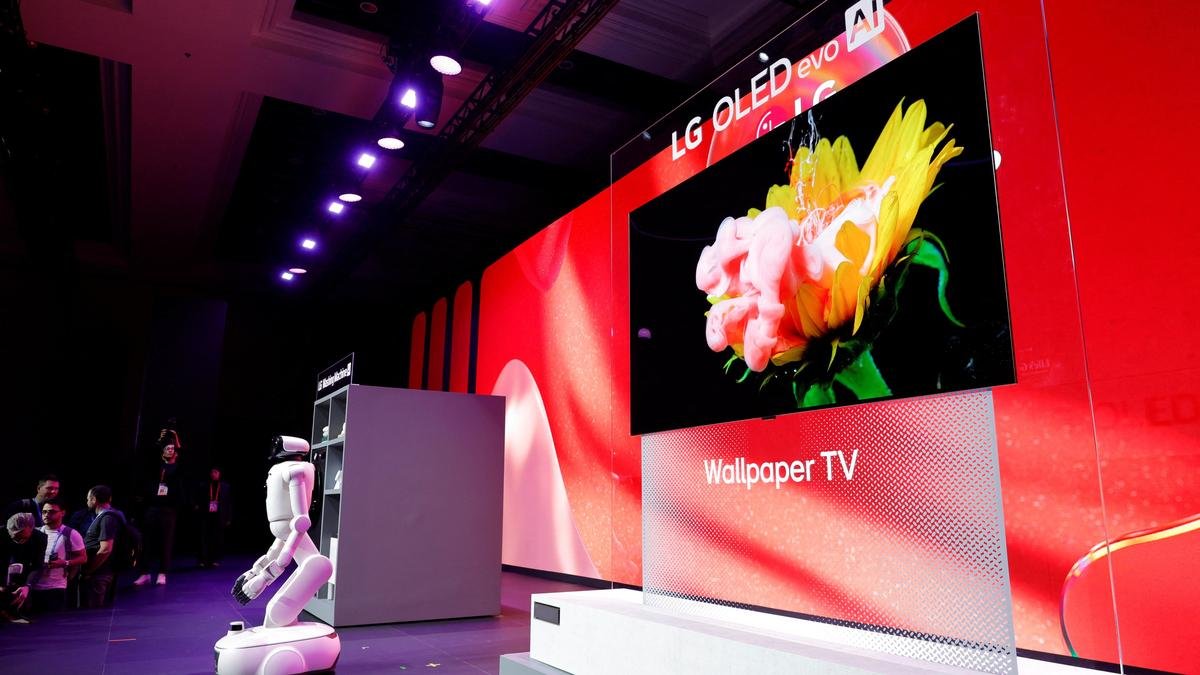
A big theme at CES 2026 in Las Vegas is that TV brands are trying to “re-invent” the living-room screen for an era where the real default screen for younger viewers is often a smartphone. In other words: TV makers aren’t only competing with each other anymore—they’re competing with the habit of watching everything on a phone, in short bursts, in bed, on the bus, or between classes.
That’s why so many announcements this year sounded less like “here’s a new panel” and more like “here’s a new computer that happens to be a screen.” The buzzwords—AI picture, AI sound, AI personalization, AI assistants, AI recommendations, AI translation, AI wallpapers, and “smart home hub”—are all part of a strategy to keep TVs relevant, premium, and profitable even if unit growth is flat.
1) Why the “smartphone threat” is suddenly a big deal for TV makers
The basic problem is simple: people still own TVs, but attention is moving elsewhere.
Market trackers have been showing a steady shift in viewing behavior: the share of daily viewing done on TV sets has been falling, while smartphones have risen sharply. One widely-cited set of numbers discussed around CES this week: TV-set viewing dropping from 61% (early 2017) to 48% (late 2025), while smartphone viewing nearly doubling to 21% over the same period.
Industry researchers describe it as a generational split: older audiences often still treat TV as the “main screen,” while younger audiences are comfortable consuming long and short content on phones, tablets, and laptops.
And it’s not only about where people watch. It’s also about how content is packaged now:
- Short-form video is optimized for vertical phone screens.
- Social discovery (what friends share, what an algorithm pushes) happens on mobile.
- Even “TV-like” shows are marketed, clipped, memed, and discussed through phone-first platforms.
So TV makers face a dilemma:
- If they only sell “slightly better screens” each year, that won’t fight phone habits.
- If they want you to upgrade, they must sell you a new experience—bigger, smarter, more personal, more helpful, and more integrated with your life.
That’s where AI becomes the story.
2) What “AI upgrades” really mean on TVs (beyond marketing)
At CES, “AI TV” usually means a bundle of features across five areas:
A) AI picture processing (upscaling, contrast, color, motion)
Most “AI picture” claims revolve around the TV’s processor analyzing frames in real time and applying enhancements:
- Upscaling: making HD/2K content look sharper on 4K/8K panels.
- Noise reduction: cleaning compression artifacts (especially streaming).
- Object/scene detection: recognizing faces, skies, grass, text, sports fields, etc.
- Dynamic tone mapping / HDR optimization: adjusting brightness and contrast scene-by-scene.
Samsung, for example, heavily promoted AI-led picture and sound processing across its 2026 sets, including AI upscaling and HDR-related enhancements.
The important detail: these improvements can be genuinely noticeable, but they’re also subjective. Over-processing can look unnatural if tuned aggressively—so a lot of “AI quality” comes down to how well brands balance realism vs. pop.
B) AI sound processing (dialogue clarity, room adaptation)
Many 2026 TVs are trying to reduce the need for a soundbar by using AI to:
- Separate dialogue from background audio.
- Adapt sound output to room acoustics.
- Emphasize sports commentary or movie effects depending on content type.
In practice, great audio still benefits from external speakers, but AI can improve the “straight out of the box” experience—especially for apartments and casual viewers.
C) AI personalization (profiles, mood, recommendations)
This is where TVs are copying the smartphone playbook:
- Personalized recommendations
- Multiple user profiles
- Content continuation across devices
- “For you” rows everywhere
TV makers want the home screen to feel like your feed, not a generic menu. This is partly about convenience, but it also supports the next big battleground: advertising and commerce (more on that below).
D) AI assistance (voice, Q&A, copilots, multi-assistant support)
Brands increasingly want TVs to function like a living-room assistant: ask questions, search across apps, summarize what you’re watching, or control smart home devices.
Samsung’s CES messaging emphasized embedding AI “across every area, every product, and every service,” positioning TVs as part of a wider AI-living ecosystem.
E) AI features that feel “new” (translation, generative art, smart routines)
These are the headline grabbers:
- Live translation/subtitle enhancements
- Generative wallpapers/art modes
- Voice-built routines (smart home automation)
Even if people don’t use these daily, they create the perception that a new TV is meaningfully “new,” not just a slightly brighter rectangle.
3) The other big strategy: go massive (because phones can’t do this)
If phones win on convenience, TVs try to win on immersion.
That’s why CES 2026 showcased a parade of super-sized screens—100 inches, 115 inches, and beyond—because a phone simply cannot replicate the shared, cinematic feel of a giant display. Samsung, for instance, highlighted very large Neo QLED options (including 100+ inch classes) as part of its 2026 push.
There’s also a pricing strategy here:
- Global TV ownership is stable or declining in many regions and prices can be pressured.
- So brands try to protect revenue by convincing buyers to “trade up” to a bigger and more premium model—often with a big margin boost.
This is why you heard so much talk about “largest ever,” “ultra-premium,” and new display tech.
4) “Micro RGB” and the war of display tech at CES 2026
One of the most talked-about show-floor concepts this year is Micro RGB—a display approach that aims to push color precision and brightness control.
Samsung promoted a 130-inch Micro RGB TV, billed as the world’s first of its kind at that size, and framed it as a next-gen ultra-premium category.
At a high level, these “new tech” demos serve two purposes:
- Brand halo: even if few people buy a 130-inch ultra-premium set, it signals leadership.
- Trickle-down roadmap: features and manufacturing lessons can later influence more affordable models.
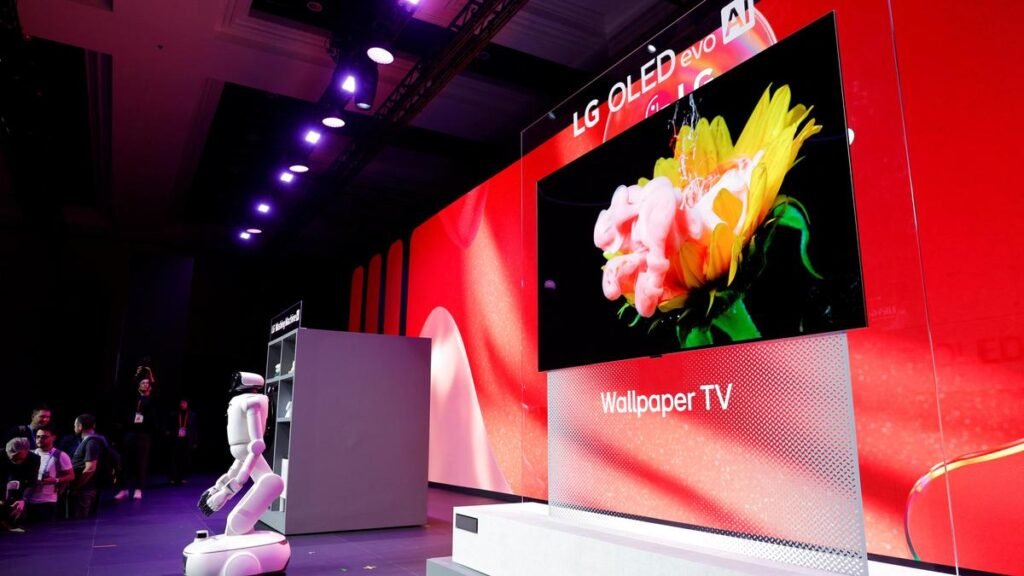
At CES, competitors like LG and others also showcased innovations around large screens, premium panels, and AI-led processing—because no one wants to look behind in the “best screen” arms race.
5) Projectors are joining the fight: the “living room war” isn’t only TVs now
Another interesting CES shift: premium projectors are being marketed as alternatives to giant TVs, especially for people who want a huge image without permanently mounting a massive panel.
At CES 2026, brands including Samsung, LG, and Hisense showcased AI-enhanced projector concepts and new models aimed at making projection easier and more “TV-like” (smart platforms, auto-adjustments, and simplified setup).
This matters because it expands the definition of “TV market.” If you can get a clean 100–150 inch experience with fewer compromises, you might skip buying a massive TV panel entirely.
6) The hidden business battle: TVs are becoming advertising and commerce machines
One of the most important (and less glamorous) parts of this story is that the TV is increasingly treated as a platform, not a one-time hardware sale.
A key quote/theme raised by analysts around CES: TVs are shifting from “profit from hardware” to “profit from ads and services,” turning the home screen into a high-value storefront.
Amazon vs. Walmart: why they care so much about your TV screen
Behind the scenes, Amazon and Walmart are battling for influence in connected TV advertising and commerce—because the living room is a powerful place to shape buying decisions.
- Amazon has long used Fire TV and Prime Video as parts of a broader ad and commerce ecosystem (including “device ads” placements across Fire TV surfaces).
- Walmart made a major move by acquiring Vizio and its SmartCast platform for about $2.3 billion (a deal announced in February 2024 and completed in December 2024), explicitly tying it to expanding Walmart’s advertising business.
This matters for TV makers because:
- The operating system and ad inventory can be worth as much as (or more than) the panel margin over time.
- Control of the TV interface means control of what people see first: recommended shows, featured apps, sponsored tiles, and shopping prompts.
In short: the modern TV is becoming a “living room OS.” And AI helps that OS feel more personal—while also making ads more targetable and measurable.
7) Why AI is the perfect tool for the TV industry’s goals
It’s not an accident that AI is everywhere in CES TV messaging. AI helps TV companies solve multiple problems at once:
Problem 1: “People don’t upgrade often.”
AI lets brands claim meaningful improvements year-to-year: better upscaling, smarter audio, personalized features.
Problem 2: “Phones are stealing attention.”
AI tries to make TV more effortless than a phone: voice search, content discovery, automatic optimization, and big-screen immersion.
Problem 3: “Hardware margins are tight.”
AI features support subscription services, data-driven recommendations, and ad businesses—new recurring revenue streams.
Problem 4: “Streaming quality varies a lot.”
AI processing can hide compression and improve perceived quality even when content is imperfect.
So AI becomes the Swiss army knife: marketing story + product improvement + platform monetization.
8) The skeptic’s view: will “AI TVs” actually change behavior?
There’s also real skepticism. Analysts at CES have openly questioned whether companies can prove AI features live up to the claims, especially when demos are tightly controlled.
And some consumer realities remain stubborn:
- Many people use TVs in simple ways: open Netflix/YouTube and press play.
- Some AI features may feel like clutter rather than value.
- Privacy concerns can grow when TVs become ad-tech and data platforms.
So the near-term outcome may not be “AI changes everything overnight,” but rather:
- AI becomes a standard layer in TV processors (like HDR did),
- some features stick (upscaling, dialogue clarity),
- while others remain niche (generative wallpapers, novelty assistants),
- and the bigger long-term change is the platform economics: ads, commerce, and operating systems.
9) What this means for buyers in 2026
If you’re shopping this year (or advising someone who is), the CES trends translate into practical takeaways:
- The biggest visible upgrade is size + brightness.
If you move from 55 to 75+ inches, you’ll feel a bigger difference than many “AI” features. - AI upscaling matters if you watch lots of non-4K content.
Especially sports, YouTube, cable, and older shows. - Smart platform quality matters more than ever.
Speed, app support, update policy, and interface design can shape daily happiness. - Be aware of the ad layer.
Many “smart TV” platforms are increasingly ad-driven. Some brands/OSes are more aggressive than others. - Projectors are becoming a serious alternative if you want 100–150 inches and can control lighting.
10) The bigger picture: TVs are not dying—they’re changing roles
The headline “smartphone threat looms” is real, but it doesn’t mean TVs are disappearing. It means the TV’s job is changing:
- From a passive box to a personalized screen computer
- From one-time purchase to services + ads + commerce
- From “best picture” to “best experience + best ecosystem”
- From isolated device to smart home hub
CES 2026 made it clear that TV makers believe the living room is still worth fighting for. The weapon they’re choosing is AI—partly because it improves real things (picture and sound), and partly because it helps transform TVs into profitable platforms in a world where screens are everywhere.
Related CES coverage on AI TVs and the screen wars