Daksh Pandey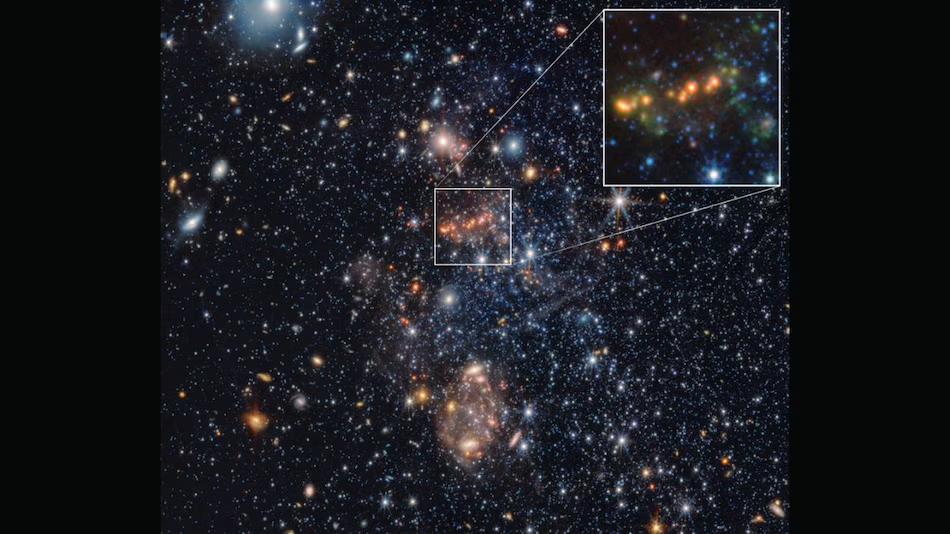
The discovery made by the James Webb Space Telescope (JWST) is one of the most revolutionary moments in the history of astronomy. It has not only added new information to our understanding of space but has deeply challenged the established scientific methods that were used for decades to explain how the early universe formed and evolved. Before JWST, scientists had a fairly clear picture of what the early universe should look like: dark, simple, slow, and gradually developing. After JWST, that picture has changed dramatically. The early universe now appears to be bright, complex, energetic, and surprisingly mature, far beyond what human imagination had previously allowed.
For many years, our understanding of the cosmos was shaped mainly by observations from the Hubble Space Telescope. Hubble showed us stunning galaxies, nebulae, and star-forming regions, and it helped establish the idea that galaxies evolved slowly over billions of years. According to traditional cosmological models, the first few hundred million years after the Big Bang should have been a “cosmic nursery,” where small clouds of gas slowly came together to form the first stars and tiny primitive galaxies. Large, massive, and well-structured galaxies were expected to appear much later in the universe’s timeline.
However, JWST has completely disrupted this belief. By observing galaxies that existed just a few hundred million years after the Big Bang, JWST has shown that the early universe was already hosting massive, bright, and well-organized galaxies. This was shocking because it suggests that galaxy formation happened much faster than scientists had predicted. The universe did not take billions of years to become complex; it became complex almost immediately on a cosmic timescale.
The phrase “challenged the established methods” becomes very meaningful here. Astronomers use mathematical models and computer simulations to predict how matter should behave after the Big Bang. These models include assumptions about how quickly gas cools, how stars form, how dark matter shapes galaxies, and how gravity pulls matter together. JWST’s observations suggest that many of these assumptions are incomplete or inaccurate. The universe seems to have worked more efficiently and more rapidly than our equations allowed.
What makes this discovery so powerful is that it does not just add a new chapter to our understanding of cosmic history; it forces us to rewrite earlier chapters. When scientists saw JWST’s first images of extremely distant galaxies, many initially believed there must be an error. Some even thought the data was misinterpreted because the results were too unexpected. But as more observations were confirmed, it became clear that the telescope was revealing something real and extraordinary.
In simple words, JWST showed us that the early universe was not a quiet, slow-growing place. It was alive with activity. Stars were forming at astonishing speeds. Galaxies were assembling rapidly. Chemical elements were being created sooner than expected. Structures that were supposed to take billions of years to develop were already in place within a few hundred million years.
This discovery also has a deep philosophical impact. Humans have always imagined the beginning of the universe as chaotic but simple. We believed complexity took a long time to emerge. JWST shows us that complexity might be a natural and immediate outcome of cosmic creation. The universe did not wait to become beautiful and structured; it was born that way.
In many ways, JWST has become a time machine. When we look through it, we are not just seeing distant objects; we are seeing the universe as it was billions of years ago. Each image is a message from the past, telling us that our old ideas about cosmic history were limited. The early universe was not beyond imagination because it was empty or dark, but because it was already filled with astonishing richness and order.
This is why scientists say that JWST has started a new era of astronomy. It is no longer about refining small details; it is about rethinking the foundation of how we understand cosmic evolution. The telescope has challenged traditional timelines, questioned long-standing theories, and opened doors to new physics.
Before the launch of the James Webb Space Telescope, scientists had developed a fairly well-structured understanding of the early universe based on observations, mathematical models, and computer simulations. This understanding was strongly influenced by data from the Hubble Space Telescope, the Cosmic Microwave Background (CMB) studies, and theoretical physics. According to these sources, the early universe was thought to be simple, dark, and slowly evolving. Complexity, brightness, and large-scale structures were believed to appear only after a long period of gradual development.
The standard model of cosmology, known as the Lambda Cold Dark Matter (ΛCDM) model, formed the backbone of this belief. It describes a universe that began with the Big Bang around 13.8 billion years ago and expanded rapidly. In its earliest moments, the universe was extremely hot and dense. As it expanded, it cooled down, allowing basic particles to combine into atoms, mainly hydrogen and helium. This period was followed by what scientists called the “Dark Ages,” when no stars or galaxies existed yet.
During these Dark Ages, the universe was filled with neutral hydrogen gas and dark matter. There was no visible light because no stars had formed. Gravity slowly began pulling matter together into small clumps. Over millions of years, these clumps grew denser and eventually collapsed to form the first stars. This phase marked the beginning of the “Cosmic Dawn.”
Scientists believed this process was slow and inefficient. The first stars were expected to be massive but rare, and the first galaxies were predicted to be small, faint, and primitive. Large galaxies like the Milky Way were thought to require billions of years of mergers and growth. According to these models, galaxies in the first 300–500 million years after the Big Bang should have been tiny and difficult to detect.
Hubble’s observations seemed to support this view. Although Hubble could see far into space, it struggled to observe the very earliest galaxies because their light had shifted into infrared wavelengths, beyond Hubble’s strongest capabilities. The few early galaxies it did detect were small and faint, reinforcing the idea that early cosmic structures were simple and underdeveloped.
Another major assumption was about star formation efficiency. Scientists believed that early gas clouds were not very good at forming stars. The gas was hot, unstable, and affected by radiation, which slowed down star birth. As a result, galaxies were expected to grow gradually, not explosively.
The early universe was also thought to be chemically simple. Only hydrogen and helium were created in the Big Bang. Heavier elements such as carbon, oxygen, iron, and silicon form inside stars and are spread through supernova explosions. Therefore, early galaxies were expected to lack these heavy elements and be extremely “metal-poor.” Rich chemical environments were assumed to develop much later.
Dark matter played a crucial role in these theories. Scientists believed that dark matter formed invisible “halos” that acted as gravitational scaffolding. Normal matter would slowly fall into these halos and form galaxies. However, this process was believed to take a long time. The idea that massive galaxies could form so quickly did not fit comfortably within this framework.
In summary, before JWST, the early universe was imagined as:
Dark and quiet
Chemically simple
Slowly forming stars
Hosting only small, primitive galaxies
Structurally immature
The universe was thought to be like a baby, gradually learning to walk before becoming complex. Time was seen as the essential ingredient for beauty and order.
This is why JWST’s discoveries were so shocking. It did not find a universe taking its first hesitant steps. Instead, it found a universe that was already running. Bright galaxies, massive star systems, and complex structures were present far earlier than expected.
The old models were not completely wrong, but they were incomplete. They underestimated how quickly nature could organize matter and create complexity. JWST forced scientists to accept that the early universe was not a simple place slowly waking up—it was already vibrant, energetic, and astonishingly advanced.