Daksh Pandey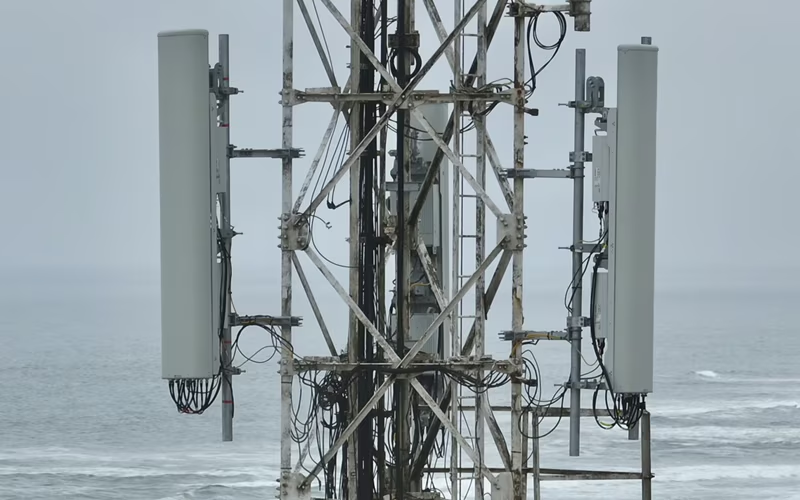
Claro Peru and Huawei’s “first commercial deployment of the world’s first EcoMatrix site” is, at its essence, a tale of the evolution of mobile networks towards lean, green, and easy-to-expand networks, especially in those markets where operators face pressure to increase capacity quickly but are concurrently affected by increasing electricity costs, rental of tower sites, and complex multi-band solutions. It was done in Lima, Peru, and Huawei describes this solution as a new site solution that supports various frequency bands with a reduced number of components, lower power consumption, and enhanced radio performance.
After this, I’ll go into detail about what each term means, what has been rolled out, its relevance, and its impact for those operating and interacting with it—the answers will be told in “3000 words,” as requested.
- 5G
5th Generation.
The fifth generation of wireless network technology.
1) What happened in simple words
Claro Peru (a major telecommunications carrier in Peru) and Huawei launched what they claim to be the first commercial EcoMatrix cellular installation. The significant point about this installation is that it allows Claro Peru to install all sub-3 GHz carriers on one pole in a way that is much more integral to the traditional cellular tower installation.
Huawei and Claro have noticed “actual test” benefits:
1.8 dB improved coverage
30% less space for antenna installation
35% overall energy savings
These metrics are more than just fluff—each and every one of them relates to an issue that exists in the industry for operators.
2) The real problem operators are facing (why a “new site design” is even needed)
One thinks that mobile communication is only about the frequency and cell sites. But the reality is that the war is largely fought at the site level because:
a) OPEX continues to increase
With the increased use of mobile networks for video,/social media applications, cloud computing, IoT, and now AI services, the need for additional capacity continues. This not only translates into additional infrastructure, power utilization, maintenance visits, and increased complexity, pushing OPEX costs year by year. This is exactly the context in which Huawei presents the problem at Claro Peru.
b) Towers are pricey—and at times costed in a manner that punishes “big” builds
One of the most interesting parts of the press release is related to the wind load area for tower leases in Latin America. Apparently, some tower operators factor wind load area into tower leases. Wind load area is roughly “how much is on the tower that blows in the wind.” There may be many antennas, RRUs, towers, and cables in a traditional two-band site, making it a “busy tower,” which is more exposed to wind and thus may be more costly to lease.
So, by reducing the physical presence (and, by extension, the wind load), you now have the possibility of reducing tower costs, or at least of gaining approvals for upgrades.
c) Cost of energy is now a strategic issue.
Base stations with low energy efficiency require high power consumption, while power costs or conditions in the power supply industry can make power a key cost driver.
“The whole narrative Huawei has about EcoMatrix is tied to energy efficiency and sustainability, which is what the operators’ direction is generally trending towards.”
d) Complexity involving multi-bands does occur
“Operators don’t work ‘one band.’ They work multiple bands because each band has different strengths:” They may start at a certain frequency, feeling comfortable
Lower bands (for example, 700/850 MHz) assist with coverage and penetration.
The mid bands, for example 1.9/2.6 GHz, assist with capacity in
But where there’s a need for multiple frequency ranges, there’s a possible downside in that it can mean additional hardware, installation time, cable loss, components to go wrong, and troubleshooting.
Huawei specifically states that “Claro was struggling to simplify deployment and management in a multi-band environment,” and EcoMatrix solves this.
3) So what is this “EcoMatrix”
According to the description provided by Huawei, EcoMatrix is more than just “one antenna.” It’s a highly integrated site solution consisting of radio and antennas designed in a manner that supports multiple bands below 3 GHz in a compact physical structure.
The press release describes that there are four key advantages that outline what the system comprises. The four key advantages are summarized below.
Easy website hosting
Very low power consumption
Excellent performance
Feedback
Best Evolution (Easy Scalability & Upgrade Paths)
NF-G
Now, let’s break these down, because details count.
4) Benefit #1 – Simplifying deployment of sites (reducing “boxes”)
Huawei says that Claro Peru has been able to launch operations on 700 MHz, 850 MHz, 1.9 GHz, and 2.6 GHz on a single pole with its EcoMatrix system and only requires three boxes per location vs. 15 boxes.
“Boxes” is a very important principle in tower design.
What is meant by “three boxes vs fifteen”?
Some common sampling areas may incorporate:
Several RRUs for each band
Separate antennas or multi-port antennas
Combiners, filters, junction boxes
Cables for connecting (jumper/
Brackets, supports, protective enclosures
In the case of numerous independent modules, you have:
Longer installation time
More points of failure
Greater weight force
Greater wind force
Lower reliability
Complexity level
So, based on EcoMatrix’s ability to minimize the number of physical elements, the following are some of the things that Claro
Launch new sites quickly
Upgrade sites faster
Lessen tower congestion
Possibly lower leasing costs based upon wind load area (subject to towerco policies)
This is particularly important in urban areas where space in towers is scarce and in countries where acquiring site permits can take longer.
5) Benefit #2 – Consumes very little energy (why 35% matters)
Huawei claims that their EcoMatrix radio units incorporate GigaGreen RRUs, with this commercial deployment realizing a site-wise energy saving of 35%. It also points out other future energy savings to be realized in their “0 Bit 0 Watt” dormancy mode, as well as future GigaGreen RRUs offering flexible support with their EcoMatrix solution.
Why is energy saving at the site level very valuable?
Since energy cost is much more than “a little overhead.” In many operators’ financial models:
The power can be one of the largest OPEX expenses.
The saving potential at thousands of sites adds up to substantial sums.
Reduced energy consumption is also beneficial for fulfilling ESG considerations.
What does “0 Bit 0 Watt” deep dormancy signify?
Even without using highly technical terms, it’s obvious that what’s intended here is that during low PDP (traffic) times (e.g., late night regions), certain parts of the radio access network can enter a deep sleep mode to cut consumption. Telco infrastructure efficiency upgrades and smart power management are often used in overall Huawei sustainability messaging.
It would seem that a dormant system that works and is safe (does not impair the ability to serve when urgently needed) could provide a continuous approach based on energy conservation.
6) Benefit #3 — Better Performance (Coverage and Efficiency, not “Green”)
Huawei claims that EcoMatrix delivered an improved coverage of 1.8 dB and incorporates technologies that minimize loss within the radio/antenna chain.
There are two technical points of interest regarding the performance of the species in the press release:
EcoMatrix also incorporates “true ultra-wideband RRUs and antennas”
It uses the SDIF (signal direct injection feeding) process to eliminate the use of cable. This boosts performance due to the reduced feeder loss and internal insertion loss.
How does removing cables enhance connectivity?
Cables/Connectors induce losses. With time, weather factors, connector age, and installation practices contribute to increased losses. If the design minimizes RF cable component lengths/counts, perhaps through a different method of input of the radio output into the antenna system, it could lead to reduced losses.
What difference does the “1.8 dB better coverage” actually make?
“Nothing” is not 1.8 dB. In radio networks, even small improvements in dB values can mean:
Improved indoor coverage in marginal regions
Less dead zones
Improved uplink/downlink in cell edge regions
May be lower number of sites required to achieve coverage target (terrain and clutter dependent)
And if this can be done with a smaller footprint and less energy use, this is what network operators want, as it gives improved network performance for less.
7) Benefit #4 – Optimal evolution (future-proofing without rebuilding towers)
Huawei highlights EcoMatrix’s modularity. They claim that while land is limited, telecoms can expand their networks with available spectrum resources. In other words, there is no need to construct new poles to support added wireless communication infrastructures. The company suggests phased roll-out efforts based on available spectrum. This is to ensure that future costs remain contained.
This is significant since the frequency spectrum is generally relinquished in stages by the regulating authority. The operators also do not always acquire all the spectrum simultaneously. The design of the website should enable the operators to acquire the frequency in phases. This would minimize the number of “rip and replace” cycles.
In addition, in dense urban skyscrapers, “no more room” is literally an obstacle. Wherever EcoMatrix can cut antenna real estate by 30%, this directly assists in building an evolution theory.
8) How/where Claro Peru is particularly favored (linking the technology with market conditions in Peru)
Claro Peru competes in an environment characterized by:
- Multi-h
Urbanization and Demand for Data
Strong competitive force to improve coverage and speed
“Practical” constraints related to the deployment of the network, such as:
Tower
Huawei’s roll-out specifically associates EcoMatrix with Claro’s:
OPEX increases
Tower wind load / leasing problem
Energy cost pressure
Complexity of Multi-band Deployment
Hence, it would seem that, as far as Claro is concerned, EcoMatrix is attractive because it focuses on addressing just the right “hidden costs” of operating a mobile communications network.
The CTO of Claro in Peru, Juan David Rodríguez, is cited as saying that EcoMatrix enables the deployment of more bands in a reduced footprint, the optimal use of sites and spectrum resources, and evolution towards continuous 5G.
This quote may still be “bureaucratic speak,” but it suggests a need: more capacity and bands without having to rebuild again.
9) The relevance to broader telecom trends: “network economics” and “green networks”
EcoMatrix is part of an overall industry movement where operators and suppliers increasingly speak less of pure speeds and more of overall network economics:
Cost per bit
Energy per bit
Faster deployment by site
Automation and Simplified Operations
This is reflected in Huawei’s EcoMatrix messaging. For instance, in an article about thetelecommunications industry, EcoMatrix is introduced as “ultra simplified, greener infrastructure” and the energy saving and “0 Bit 0 Watt” dormancy mechanism is reiterated.
Mobile World Live
Huawei also has overall telecom energy solution portfolios to reduce energy consumption in telecommunications networks and simplify deployment.
The company has established leading industry standards in terms of power supply, energy
Therefore, whether you love or hate vendor marketing, this trend is for real: “Building networks that scale without scaling expenses is a kind of nirvana that we all aspire to.”
10) What could change for customers (normal mobile users)
Whether Claro gets the ball rolling in more than one location (being a commercial announcement for the initial implementation, not a mainstream launch), customers will enjoy the following treatment:
a) Improved coverage consistency
If this improved coverage proves true under different conditions, then consumers may enjoy:
Reduced Call Drops
Improved indoor signal
Better data sessions in edges of coverage regions
b) Improvements in speed during peak times
There are ways in which capacity can be improved through better utilization of the spectrum or combining multiple bands. It doesn’t always translate to “faster speeds” but can ensure a more reliable experience.
c) Faster network expansion
If the deployment process is easier (now requiring only three boxes instead of fifteen), this enables Claro to enhance their sites faster, which is most important in times of heightened demand and/or competition.
11) What it means for operators globally (why ‘world’s first commercial’ is important)
When a supplier says “world’s first commercial deployment,” they’re also signaling to other carriers:
This isn’t just a prototype
It has been installed, tested, and is functioning.
It has measurable outcomes
Huawei asserts that “the deployment with Claro Peru proves the value of EcoMatrix, which can be used for building a ‘lean, green, and efficient network that scales easily.’ ”
If other carriers are facing similar challenges (tower space + energy cost + multi-band complexities), then they may consider the EcoMatrix design a template.
12) A realistic perspective: what we don’t know yet from the news
Even with such impressive figures, the following could be observed about the limits that exist with regard to the information that is made available:
Scale: “It does not mention how many EcoMatrix sites are being installed by Claro—the first commercial site has been installed.”
Test conditions:
“1.8 dB better coverage” depends on baseline, baseline placement, clutter, network design.
We don’t see full methodology here either.
Total cost of ownership (TCO): The cost savings on energy are great; however, other factors include equipment costs and dependence on vendors. The press release does not offer details on pricing and ROI.
– Greater interoperability: The carriers will occasionally mix vendors. It is a Huawei initiative, but the details are not specified.
Nonetheless, none of these means that the reports are not true–simply that until full-scale implementation, one cannot claim definitive, concrete truth.
13) Why “sub-3 GHz on a single pole” is strategically important, especially for 5G Evolution
There is much 5G marketing talk centered on mid-band and mmWave, but for many countries, the heart of 5G deployment is still centered on these bands:
Low bands for coverage
The low band
Mid bands for capacity
If EcoMatrix makes it easier to deploy multiple sub-3 GHz bands with reduced clutter and lower energy, then it supports “the foundation for 5G evolution.” The message from Huawei and Claro is clear and links their proposed solution to their readiness for continuous 5G evolution and flexible spectrum expansion.
14) Bottom line This launch matters because it’s not about a faster processor or a “cool phone feature”—it’s about a change in the physical-economic structure of cellular towers. The first commercial EcoMatrix installation by Huawei and Claro Peru boasts three major victories at once: Coverage increases (Improvement of 1.8 Physical footprint reduced (less space to install antennas by 30%) Use of energy declines significantly (achieves 35% of total saving If such outcomes can be scaled, the EcoMatrix design approach may prove representative of the kind of networks carriers will have to build themselves in the event that every increment of gigabytes carried is not accompanied by commensurate increases for the cost of powering the system and tower leasing fees.