Daksh Pandey
The “OnePlus 15T” (sometimes also paired with a “15s” in leak parlance) comes up in discussion as OnePlus’ next compact flagship-a phone designed to deliver top-tier performance in a smaller body than the main “OnePlus 15”-style device. For now, nothing is officially confirmed about a 15T, so the safest way to read these tips might be: early internal testing + supply-chain chatter + tipster interpretation. Still, when multiple reports repeat the same core details, you can start seeing a likely direction.
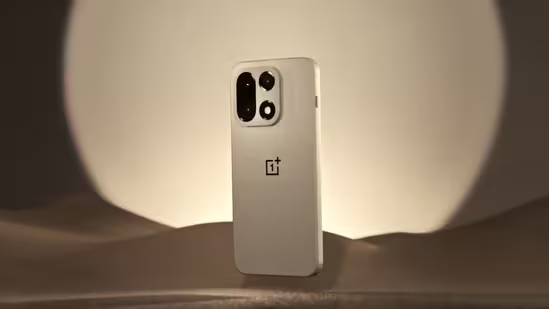
Below is a detailed, leak-by-leak style breakdown of what’s circulating-mostly around the display and key specs-plus what it might mean in real-world usage.
1) Big headline: compact phone with “flagship-grade” display
Probably screen size: ~6.3 inches flat
Most of the current chatter points to a display around 6.31–6.32 inches with a flat panel; this is consistent across multiple writeups summarizing what in essence is the same set of underlying tipster claims.
Why this matters:
The sweet spot hits around 6.3 inches for people who want comfort-one-handed without dropping into truly small-phone compromises: tiny battery, weak cooling, etc. Flat panels also tend to be easier to protect with screen guards and are less prone to accidental touches than aggressive curves.
Probably solution: “1.5K”
The leaks repeatedly mention 1.5K resolution, which is common mid-high tier between 1080p and QHD.
What “1.5K” usually means:
You get crisp text and great detail, with the added bonus of an often-lower GPU workload than full QHD for better efficiency (read: battery) and more stable gaming high frame rates, especially in a compact device where heat is harder to manage.
Probably panel technology: OLED – BOE
A number of the reports actually specify a BOE OLED panel – sometimes these are phrased as “BOE X3 OLED”.
How to interpret that:
BOE supplies many excellent OLEDs today. The bigger question isn’t the supplier name—it’s whether OnePlus tunes it well: brightness behavior, PWM dimming, color calibration, and LTPO/variable refresh behavior (more on that next).
Refresh rate: a very bold “165Hz” rumor
A lot of the current coverage claims 165Hz refresh rate for the 15T.
Real Talk on 165Hz:
165Hz looks really buttery while scrolling and in games that can actually render over 120fps.
But it can be a battery tax if the phone can’t dynamically drop refresh rate aggressively.
Even OnePlus’s own official marketing for the OnePlus 15 mentions a display “up to 165Hz” for that model, so it’d be fairly plausible they’d reuse similar tuning or target the same headline number on a sibling device.
OnePlus
LTPO / adaptive refresh: Not consistently stated for 15T (yet)
Some of those leaks emphasize refresh rate and resolution, but aren’t consistent about whether the 15T panel is LTPO (which enables very efficient dynamic refresh steps). That detail is important because a 165Hz screen is far more practical if it can drop down low, as well, in the 1–10Hz range when reading or on always-on display.
What to watch for in future leaks:
terms such as “LTPO”, “1–120Hz / 1–165Hz adaptive”, “variable refresh”;
“high-frequency PWM” (for eye comfort)
peak brightness + sustained brightness
- Performance: “flagship chip” is the point of a T model
Chipset rumoured: Snapdragon flagship – often phrased as “8 Elite Gen 5”
Several reports simply repeat that the 15T will employ the very best Snapdragon platform; naming has most often fallen to the so-called Snapdragon 8 Elite Gen 5, although naming here is leak terminology, not something OnePlus has confirmed.
What this means in practice:
It’s supposed to act like the flagship series, not some sort of “lite” version.
The real challenge is sustained performance. Compact bodies have less surface area to dump heat. To really feel flagship, OnePlus needs strong cooling design and power management.
Why the 15T performance rumors make sense
A compact flagship “T” generally aims for:
power users who hate big phones
Higher frame rate, comfort-seeking gamers
People upgrading from older “small-ish” flagships (Pixel A-series size range, older iPhones, smaller OnePlus models).
A 6.3-inch phone with a flagship chip is a killer combo, provided it keeps heat in check. Otherwise, you get benchmark bursts and then throttling in longer sessions.
3) Battery: the “small phone, huge battery” story
Rumored battery size: 7,000–7,500mAh (yes, that big)
A number of reports speak of a battery in excess of 7,000mAh, while a couple even go up to approximately 7,500mAh.
Why people are freaking out about this:
Traditionally, compact flagships sit around 4,500–5,500mAh. Jumping to 7,000+ in a compact chassis suggests:
newer battery tech (higher density cells)
That means a thicker phone or super optimized internal stacking.
Or the leak is optimistic / based on prototypes that may not ship globally.
Still, the idea isn’t impossible anymore. Battery tech and stacking designs have improved fast in the last couple of years, while brands are pushing “big battery without big phone” as the new flex.
Charging rumors: around 100W–120W wired
At least one summary of the leaks says that 100W–120W wired charging is being tested.
Android Headlines
What to watch here:
Actual charging speed depends on region; some markets get reduced wattage.
Thermal constraints in compact phones do matter: the device may throttle charging to manage heat, meaning that headline wattage might not actually translate to dramatically faster real-world 0–100%.
- Cameras: A different choice that may shape up the identity of this phone
Common rumor: dual cameras, 50MP main + 50MP telephoto, no ultrawide
A recurring rumor is that OnePlus may forego the ultrawide and instead provide:
The main 50MP
50MP telephoto (possibly periscope-style)
This “main + telephoto” approach is explicitly cited in some of the coverage.
Why a brand would do this:
Compact phones often have limited internal space. An ultrawide module is comparatively “cheap” in terms of space, while decent telephoto-epecially periscope-is not. Switching to telephoto from ultrawide implies that OnePlus wants the 15T to feel more “premium camera” for portraits/zoom-at the expense of wide landscape shots.
How it affects real users:
You take lots of indoor group photos, architecture, or travel scenery. You will be sorely hurt by the loss of ultrawide.
If you care about portraits, 2x–5x framing and cleaner zoom: Telephoto is a win.
Social media creators: this can make things more telephoto and cinematic, whereas ultrawide can be more dynamic. It totally depends on your style.
“Hasselblad” branding and camera tuning
Some leak imagery and writeups throw around “Hasselblad” mentions, often tied to OnePlus’ flagship camera branding, though leaks are not consistent about whether the 15T would carry the same camera co-branding or the same level of tuning. Treat that as very unconfirmed until stronger sources repeat it.
5) Build, biometrics, and “premium feel”
Metal frame: mentioned in leaks
Reports say that it had a metal frame.
It’s not uncommon to find “metal frame” in 2025-era phones, but that still provides a signal that OnePlus wants the 15T to sit above midrange devices in terms of both hand-feel and durability.
Ultrasonic fingerprint sensor: rumored
At least one report claims the 15T will have a 3D ultrasonic fingerprint sensor.
Why that’s notable:
Generally speaking, ultrasonic sensors often work better with slightly wet fingers and feel more reliable than basic optical in-display sensors—although implementation quality is a factor.
- How it might fit into the OnePlus lineup
The picture roughly looks like this at present:
One Plus 15: larger “main flagship” (official marketing trumpets a 1.5K LTPO display “up to 165Hz” on OnePlus’ site).
OnePlus
OnePlus 15R: more value-oriented, officially characterized by bringing flagship-like performance to a cheaper tier, big display, and large battery.
Android Central
OnePlus 15T: Potentially the “compact powerhouse” option; smaller screen, still top chipset, very large battery, and a camera setup that prioritizes zoom.
If this turns out to be true, OnePlus would have a nice, clean 3-way proposition: big flagship, value flagship-ish, and compact flagship.
7) Pricing and Launch Timing: What’s Being Hinted but Not Locked
Some reporting suggests that price positioning could be aggressive-even potentially cheaper than a prior “T” generation in some regions-but pricing leaks are some of the least reliable because they rely on:
changes in component costs
regional taxes
storage options
Initiate promotions and carrier offers.
So, consider price rumors to be “vibes”, rather than facts, until retail listings start turning up.
- What parts of these leaks are most believable?
When sorting leaks, I usually rank credibility like this:
More plausible: repeated and logical
~6.3” flat OLED, 1.5K: repeated and matches the “compact flagship” idea.
High refresh (probably 120Hz+; but with 165Hz an option): Repeated, OnePlus is already teasing “up to 165Hz” in the OnePlus 15 as a marketing teaser, so not outside the realm of possibility.
Flagship Snapdragon: consistent with a “T” model and repeated.
Plausible but watch closely
7,000–7,500mAh in a compact body: possible with new battery designs, but still the “wow” claim that needs confirmation.
Main + telephoto only – no ultrawide: believable as a design choice, but may change before release.
Ultrasonic fingerprint: possible, but sometimes appears in leaks because it sounds premium.
Least reliable at the moment Price – exact exact models of camera sensors The same, exact charging wattage for all its markets. Launched date details, unless OnePlus starts teasing officially 9. What this means for purchasers and creators You said “display and specs”; now, that is what the rumored combo might offer to different types of users: Whether you’re a gamer, It could be excellent: a 6.3” 1.5K OLED with very high refresh, plus a flagship Snapdragon chip, if OnePlus pairs it with: strong cooling performance that is consistently sustained. good touch response tuning Also, a smaller phone is usually easier to grip for long sessions. If you are a content creator, making Reels/Shorts, A compact phone is better for shooting handheld. A telephoto lens-if it happens-is great for portraits, product shots, and “compressed” cinematic looks. But this also means losing ultrawide-if true-reduces creativity for traveling and indoor spaces. If you are a normal day-to-day user Perhaps the biggest advantage might be in terms of battery and comfort: Big battery means fewer charge anxieties. compact body means less hand strain flat display is easier to protect. 10) Smart way to follow the 15T leaks from here If you want to track this like a pro, look for these “next proof points”: Display supplier confirmation-or consistent mention of LTPO+PWM details Explanation of Battery Technology: silicon-carbon, stacked cells, density claims Camera module constraints: does a periscope physically fit? Regulatory Listings (Model numbers listed in certification databases) Accessory leaksatables such as cases and screen protectors often prove button placement and camera bump shape. In general, once cases and protectors appear, devices are closer to real. What we can confidently say today, without overhyping it, is Based on the most repeated claims, the OnePlus 15T is being positioned in leaks as a compact, flat-screen, 1.5K OLED phone with a very high refresh rate, paired with a flagship Qualcomm chipset, plus an unusually large 7,000-7,500mAh-class battery and even some premium touches like a metal frame and possibly an ultrasonic fingerprint sensor.